
1st March Editorials & Articles
UPSC 360°
The Hindu Unwrapped – Daily Current Affairs Mastery for UPSC CSE (Clear that it’s based on The Hindu editorials / news analyses – very aspirant-friendly)
|
Significance |
|
The Strait of Hormuz crisis is a critical test of India’s energy security, as over half of its crude imports transit this chokepoint. Any disruption triggers oil price spikes, inflation, fiscal stress, and currency pressure. It underscores the urgency of diversification, strategic reserves, maritime security, and renewable energy transition. |
Strait of Hormuz Crisis: A Direct Test of India’s Energy Security and Strategic Resilience
Introduction
- The Strait of Hormuz is not merely a narrow maritime passage in West Asia; it is the world’s most critical oil chokepoint.
- Any disruption in this corridor—whether due to military escalation, geopolitical rivalry, or regional instability—has immediate global consequences.
- For India, a country heavily dependent on imported energy, instability in the Strait translates directly into economic vulnerability, inflationary pressure, and strategic risk.
The Strategic Geography of Vulnerability
- The Strait of Hormuz connects the Persian Gulf to the Arabian Sea and serves as the primary exit route for oil and gas exported by major Gulf producers.
- Nearly one-fifth of global petroleum trade passes through this narrow waterway daily. Its strategic position between Iran and Oman makes it highly sensitive to regional tensions.
- Because major oil exporters such as Iraq, Saudi Arabia, the United Arab Emirates, Kuwait, and Qatar depend on this passage, any blockade, tanker seizure, or naval confrontation can immediately disrupt global supply chains. Even the threat of closure is enough to trigger oil price volatility in international markets.
- For India, this chokepoint is not a distant geopolitical flashpoint—it is a lifeline.
India’s Structural Energy Dependence 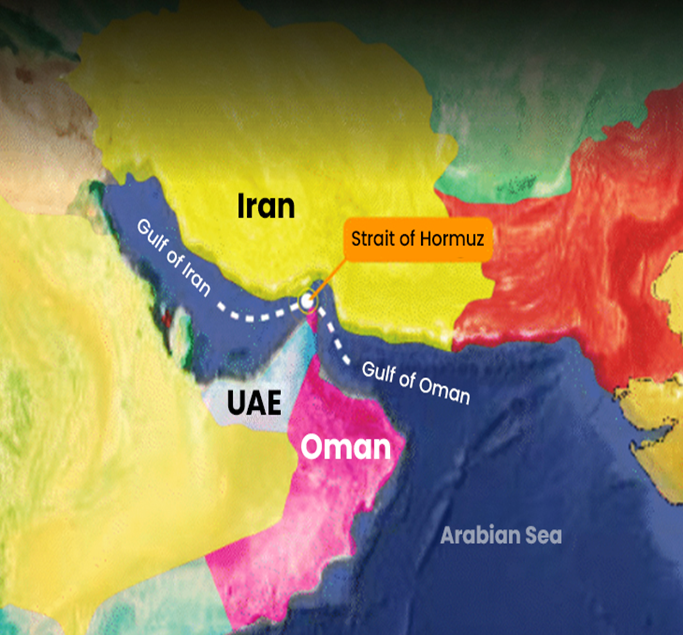
India is the world’s third-largest oil importer and imports more than 85 percent of its crude oil requirements. A significant share—around 55 to 60 percent—comes from Gulf countries whose exports must pass through the Strait of Hormuz before reaching Indian refineries.
This dependence creates a structural vulnerability:
- High reliance on imported crude
- Limited short-term alternatives
- Strong exposure to global price fluctuations
- Direct link between oil prices and domestic inflation
Thus, any prolonged disruption would immediately strain India’s external sector and macroeconomic stability.
Economic Shockwaves of a Disruption 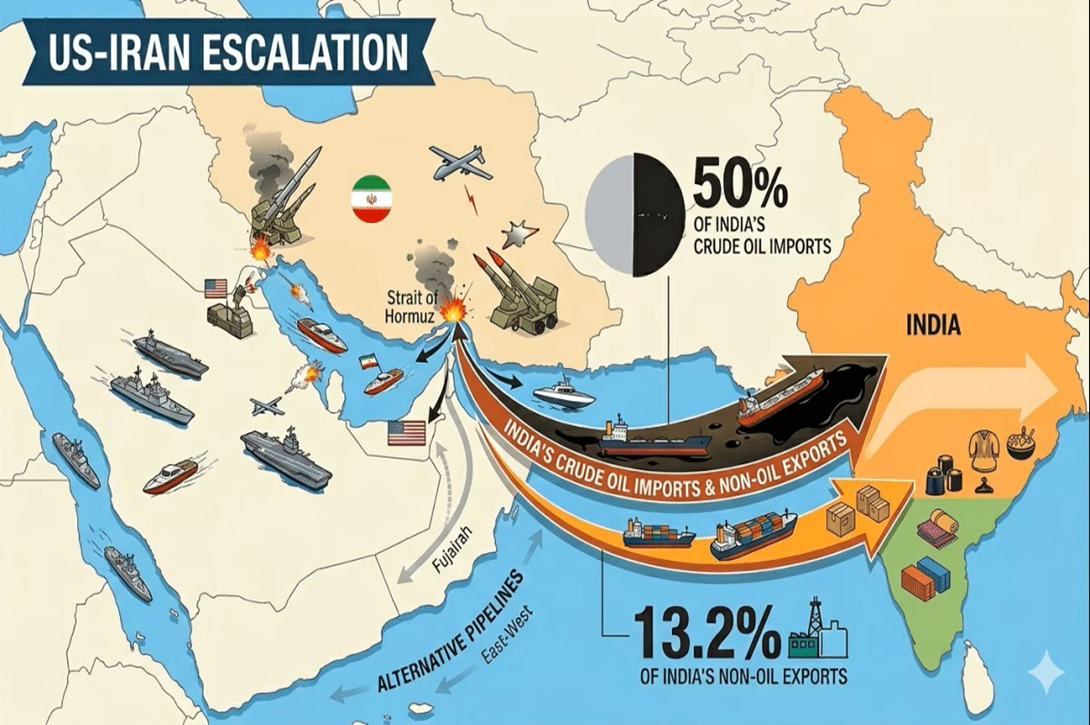
Oil Price Surge and External Imbalance
- If the Strait is blocked or threatened, global crude prices are likely to rise sharply. For India, this means a surge in the oil import bill.
- A higher import bill widens the Current Account Deficit (CAD), putting pressure on the Indian rupee. Currency depreciation further increases the cost of imports, creating a feedback loop of economic stress.
Inflationary Pressures
Petroleum products form the backbone of transportation, manufacturing, agriculture, and logistics. A spike in oil prices leads to:
- Higher petrol and diesel prices
- Increased LPG and aviation fuel costs
- Rising freight and transportation expenses
- These costs cascade across sectors, pushing up food prices and manufacturing inputs. Inflationary pressure may force the Reserve Bank of India to tighten monetary policy, potentially slowing economic growth.
Fiscal Stress on the Government 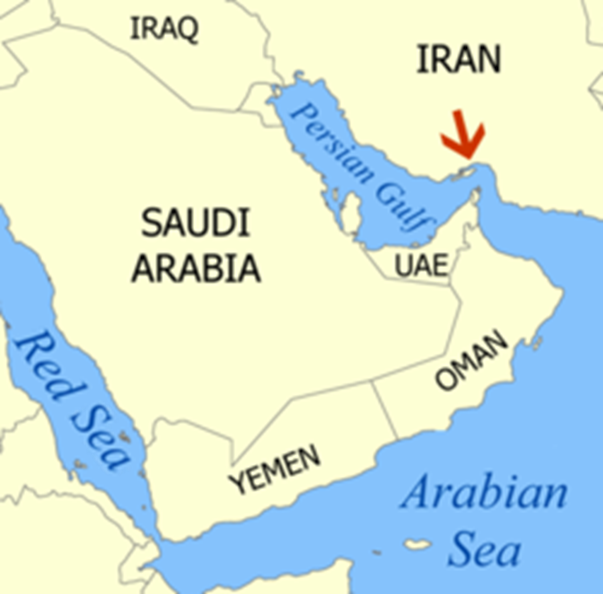
- The government faces a difficult choice during oil shocks. To protect consumers, it may reduce excise duties or increase subsidies.
- However, this weakens fiscal discipline and widens the fiscal deficit. Alternatively, maintaining high taxes protects revenue but risks public dissatisfaction and higher inflation.
- Either path places stress on India’s fiscal architecture.
Strategic and Security Concerns
Maritime Security
- Indian oil tankers passing through the Strait may face threats such as missile strikes, drone attacks, or naval blockades.
- This necessitates enhanced naval deployment in the Arabian Sea and Gulf of Oman, increasing operational costs and military vigilance.
Diaspora Vulnerability
- Over eight million Indians reside in Gulf countries. Regional escalation may require evacuation missions similar to past operations conducted in conflict zones. Such contingencies add a humanitarian and diplomatic dimension to the crisis.
Insurance and Supply Chain Costs
- War-risk insurance premiums for shipping would rise sharply. Freight rates would increase, and supply chains could face disruptions, adding indirect economic pressure beyond the oil sector.
Energy Security: Concept and Preparedness
- Energy security refers to the uninterrupted availability of energy at affordable prices. For India, it rests on four pillars—availability, accessibility, affordability, and sustainability.
- To cushion potential shocks, India has established Strategic Petroleum Reserves in locations such as Visakhapatnam, Mangaluru, and Padur. These reserves provide temporary relief but cannot sustain the economy during a prolonged disruption.
- India has also diversified imports by sourcing crude from Russia, the United States, and Brazil. While diversification reduces concentration risk, Gulf oil remains geographically and economically advantageous, limiting the feasibility of complete disengagement.
Long-Term Strategic Implications
- A serious disruption in the Strait of Hormuz could accelerate India’s energy transition. It may strengthen the push toward renewable energy expansion, green hydrogen initiatives, and domestic exploration policies.
- Furthermore, it underscores the importance of maritime diplomacy and securing Sea Lines of Communication through stronger naval partnerships in the Indo-Pacific.
- In essence, the Strait crisis reinforces the link between energy security and national security.
Conclusion
- The Strait of Hormuz represents a critical geopolitical pressure point with direct consequences for India’s economic stability and strategic autonomy. While India has taken steps through strategic reserves and diversification, its dependence on Gulf energy flows remains significant.
- Therefore, securing energy supply routes, accelerating renewable adoption, and strengthening maritime security partnerships are not policy choices but strategic imperatives.
- In the evolving global order, energy security is no longer an economic issue alone—it is a central pillar of India’s national power and foreign policy calculus.
UPSC CSE & STATE PCS Relevance
Prelims
- Key terms: Strait of Hormuz, CAD, SPR, OALP.
- Data: India's import dependence 85%; Hormuz flow 20% global oil.
- Related: Operation Raahat, NEP 2020 (energy education).
GS-2 (IR)
- India's Gulf diplomacy & multi-alignment.
- Energy as foreign policy tool.
GS-3 (Economy)
- Oil shock on inflation/CAD/fiscal deficit.
- Energy transition strategies.
GS-3 (Security)
- Maritime threats & SLOC protection.
Essay / Interview
- “Chokepoints like Hormuz: Vulnerabilities in India's Energy Security Architecture.”
- “How can India achieve energy independence amid global disruptions?”
MCQs
1. With reference to the Strait of Hormuz, consider the following statements:
- It connects the Persian Gulf to the Arabian Sea and carries about 20% of global oil trade.
- The strait lies between Iran and Oman.
- Any disruption in Hormuz would not affect India's LNG imports from Qatar.
Which of the statements given above is/are correct?
(a) 1 only
(b) 1 and 2 only
(c) 2 and 3 only
(d) 1, 2 and 3
Answer: (b)
2. India's Strategic Petroleum Reserves (SPR) provide cover for approximately how many days of crude oil imports?
(a) 9 days
(b) 30 days
(c) 60 days
(d) 90 days
Answer: (a)
3. Which of the following is NOT a pillar of energy security?
(a) Availability
(b) Accessibility
(c) Affordability (d) Import monopoly
Answer: (d)
4. The Open Acreage Licensing Policy (OALP) is related to:
(a) Renewable energy auctions
(b) Domestic oil and gas exploration
(c) EV battery manufacturing
(d) Green hydrogen production
Answer: (b)
Mains Questions
1. “The Strait of Hormuz disruption exemplifies the fragility of global chokepoints and their direct impact on India's energy security.” Discuss the economic and strategic implications and suggest a multi-pronged mitigation strategy. (15 marks / 250 words)
2. Explain the concept of energy security and its four pillars. How does India's dependence on Hormuz expose vulnerabilities in these pillars? (10 marks / 150 words)
3. “Long-term energy transition is India's best defence against chokepoint crises like Hormuz.” Critically analyse this statement with reference to renewables, domestic exploration, and international partnerships. (15 marks / 250 words)
4. Essay (250 marks) “Energy Chokepoints in a Multipolar World: Challenges to India's Security and Strategies for Resilience.”
CLICK HERE to download the PDF
