
25th February Editorials & Articles
UPSC 360°
The Hindu Unwrapped – Daily Current Affairs Mastery for UPSC CSE (Clear that it’s based on The Hindu editorials / news analyses – very aspirant-friendly)
Click here to get the PDF
|
Significance |
|
The debate on the Data Act and RTI is significant as it highlights the constitutional balance between privacy and transparency. It impacts democratic accountability, anti-corruption mechanisms, digital governance, and citizens’ right to know. Judicial and legislative responses will shape India’s future as a transparent digital democracy. |
Does the Data Act Dilute the Right to Information (RTI) Act?
Introduction
The Right to Information (RTI) Act, 2005 revolutionized governance in India by empowering citizens to seek information from public authorities, thereby strengthening democracy, accountability, and transparency.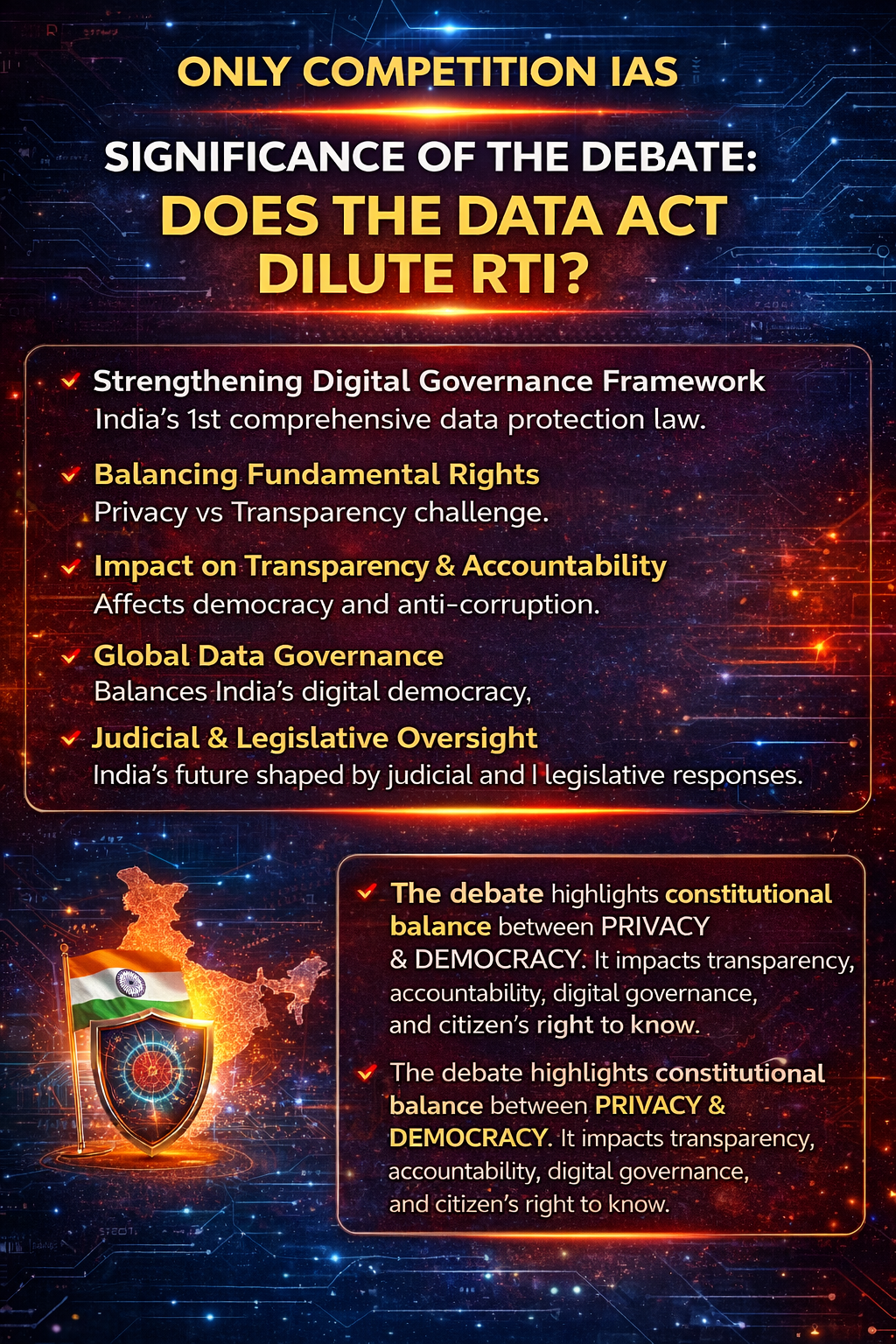
However, the Digital Personal Data Protection (DPDP) Act, 2023 has introduced provisions that may restrict access to information by expanding exemptions for personal data.
This has sparked a major debate on whether the Data Act dilutes the RTI framework and weakens democratic oversight.
The issue reflects a broader constitutional dilemma between the Right to Privacy under Article 21 and the Right to Information derived from Article 19(1)(a).
Background and Evolution of Data Protection Framework
Origin of Data Protection Law
In Justice K.S. Puttaswamy vs Union of India (2017), the Supreme Court declared the Right to Privacy as a Fundamental Right under Article 21 of the Constitution.
The judgment mandated the government to create a comprehensive data protection framework. Following this, India enacted the Digital Personal Data Protection Act, 2023.
RTI Act, 2005 – A Pillar of Democracy
The RTI Act was enacted to operationalize Article 19(1)(a) of the Constitution, which guarantees freedom of speech and expression. It enabled citizens to seek information on government decisions, public expenditure, records of public authorities, and assets and liabilities of public officials.
The RTI Act has exposed major scams such as the 2G spectrum scam, Commonwealth Games scam, and Vyapam scam, making it a powerful anti-corruption tool.
Key Provisions of the DPDP Act Affecting RTI
Section 44(3) of the DPDP Act amends Section 8(1)(j) of the RTI Act. It provides a broad exemption for personal information from disclosure and removes the explicit reference to the “larger public interest” clause.
Why is This Considered Dilution of RTI?
Blanket Exemption Without Public Interest Test
Earlier, the RTI Act allowed disclosure of personal information if a larger public interest justified it. This ensured that information about corruption, misuse of power, or conflict of interest could be disclosed. However, the DPDP Act introduces a blanket exemption without explicitly mentioning public interest, thereby creating a legal shield against transparency.
Points
- Weakens investigative journalism
- Limits citizen oversight
- Protects powerful officials from scrutiny
Threat to Democratic Accountability
Public officials are trustees of public power and public money. Their actions must be transparent to maintain democratic accountability. By restricting access to personal data such as assets, service records, and disciplinary proceedings, the Act may reduce accountability mechanisms.
Points
- Elected representatives and bureaucrats may escape scrutiny
- Reduces citizen trust in governance
- Weakens social audits and civil society activism
Constitutional Conflict Between Fundamental Rights
The Constitution guarantees both the Right to Privacy and the Right to Information. The Supreme Court has consistently held that no fundamental right is absolute. The DPDP Act, by prioritizing privacy without proportional safeguards, may violate the doctrine of harmonious construction of fundamental rights.
Points
- Violates the proportionality principle
- Risks undermining democratic transparency, which is part of the basic structure
- May be challenged as unconstitutional
Impact on Anti-Corruption Mechanisms
RTI has been a crucial tool in exposing corruption in public institutions. If personal information of officials is broadly exempted, it will be difficult to uncover benami properties, conflict of interest, and irregular appointments.
Points
- Weakens anti-corruption institutions
- Reduces deterrence against misconduct
- Encourages opacity in governance
Ambiguity in Definition of Personal Information
The DPDP Act does not clearly differentiate between private personal data and official data of public servants. This ambiguity can be misused by authorities to deny information requests even when the information pertains to public duties.
Points
- Official records may be labelled as personal
- Arbitrary denial of RTI applications
- Increased litigation burden on courts
Comparison with Global Standards
In many democracies, data protection laws balance privacy with transparency. The European Union’s GDPR allows disclosure in public interest. The UK Freedom of Information Act permits disclosure of public officials’ data. The US Freedom of Information Act allows access to government records with privacy safeguards. India’s approach appears more restrictive, potentially weakening democratic norms.
Supreme Court Jurisprudence on Transparency vs Privacy
The Supreme Court in Puttaswamy (2017) held that privacy is a fundamental right but subject to reasonable restrictions. In State of UP vs Raj Narain (1975), the Court emphasized that people have the right to know how public power is exercised. In RBI vs Jayantilal Mistry (2015), the Court highlighted that transparency is essential for democracy. Courts have consistently emphasized balancing privacy with transparency rather than eliminating transparency.
Way Forward: Balancing Privacy and Transparency
Public interest override should be reintroduced so that RTI disclosure is allowed when larger public interest exists. There should be a clear classification between private personal data and official data of public officials. Courts should interpret the DPDP Act harmoniously with the RTI Act. The Data Protection Board should be strengthened to ensure independence and accountability. Parliamentary standing committees should review conflicts between RTI and DPDP laws. Public Information Officers should be trained to balance privacy and transparency.
Conclusion
In a digital democracy, privacy and transparency must coexist. While the Digital Personal Data Protection Act is necessary to safeguard citizens from data misuse, it should not become a tool to shield public authorities from scrutiny. A balanced framework ensuring proportional privacy protection and robust transparency is essential to uphold constitutional values, democratic accountability, and citizen trust in governance.
PRELIMS MCQs (Practice Questions)
Q1. The Right to Information (RTI) Act, 2005 primarily operationalizes which Constitutional provision?
A. Article 14
B. Article 19(1)(a)
C. Article 21
D. Article 32
Correct Answer: B
Q2. The Right to Privacy was declared a Fundamental Right in which case?
A. Kesavananda Bharati vs State of Kerala
B. Maneka Gandhi vs Union of India
C. Justice K.S. Puttaswamy vs Union of India
D. ADM Jabalpur vs Shivkant Shukla
Correct Answer: C
Q3. Which of the following Acts amended the RTI Act through Section 44(3)?
A. Information Technology Act, 2000
B. Aadhaar Act, 2016
C. Digital Personal Data Protection Act, 2023
D. Official Secrets Act, 1923
Correct Answer: C
Q4. Section 8(1)(j) of the RTI Act deals with:
A. National security information
B. Cabinet papers
C. Personal information exemption
D. Trade secrets
Correct Answer: C
Q5. Which of the following Supreme Court cases emphasized that citizens have the right to know how public power is exercised?
A. Golaknath Case
B. State of UP vs Raj Narain
C. Minerva Mills Case
D. Shreya Singhal Case
Correct Answer: B
Q6. Which of the following is NOT a concern regarding the DPDP Act’s impact on RTI?
A. Blanket exemption of personal data
B. Ambiguity in definition of personal information
C. Strengthening investigative journalism
D. Reduced accountability of public officials
Correct Answer: C
Q7. Consider the following statements:
- The RTI Act allows disclosure of personal information if larger public interest exists.
- The DPDP Act explicitly retains the public interest override clause.
Which of the statements is/are correct?
A. 1 only
B. 2 only
C. Both 1 and 2
D. Neither 1 nor 2
Correct Answer: A
Q8. Which principle is used by courts to balance privacy and transparency rights?
A. Doctrine of Basic Structure
B. Doctrine of Proportionality
C. Doctrine of Severability
D. Doctrine of Colourable Legislation
Correct Answer: B
UPSC/STATE PCS MAINS QUESTIONS (GS PAPER II)
Q1. Discuss the impact of the Digital Personal Data Protection Act, 2023 on the functioning of the Right to Information Act, 2005. (10 marks, 150 words)
Q2. Examine the constitutional conflict between the Right to Privacy and the Right to Information in India. (10 marks)
Q3. “The Digital Personal Data Protection Act may dilute the transparency framework established by the RTI Act.” Critically analyze. (15 marks, 250 words)
Q4. Evaluate how the DPDP Act affects democratic accountability and anti-corruption mechanisms in India. Suggest measures to balance privacy and transparency. (15 marks)
Q5. Discuss the role of judiciary in balancing privacy and transparency in India with reference to relevant Supreme Court judgments. (15 marks)
ESSAY / CASE STUDY TYPE QUESTION
Q6. “In the digital age, privacy and transparency must coexist, but neither should overpower the other.” Discuss in the context of India’s data protection and information laws. (Essay)
