
28th February Current Affairs
Why in News?
On 25 February 2026, Pakistan launched major airstrikes on Afghan Taliban positions in Khost province, targeting alleged Tehreek-e-Taliban Pakistan (TTP) hideouts. The Taliban retaliated with artillery fire on Pakistani border posts in Kurram and North Waziristan, killing several soldiers.
Pakistan's Defence Minister Khawaja Asif warned of an "open war" if cross-border attacks continue, while Taliban spokesperson Zabihullah Mujahid condemned the strikes as "unilateral aggression" but called for "dialogue" to resolve tensions.
This escalation — the third major incident in six months — marks a dramatic collapse of the once-close Pakistan-Taliban alliance, rooted in Pakistan's post-2021 expectations of a compliant Kabul regime. Instead, the Taliban has asserted independence, leading to border clashes, TTP resurgence, and mutual accusations of harbouring militants.
The rift has broader implications for South Asian security, India's counter-terrorism strategy, and regional stability amid great-power involvement (China, US, Russia). 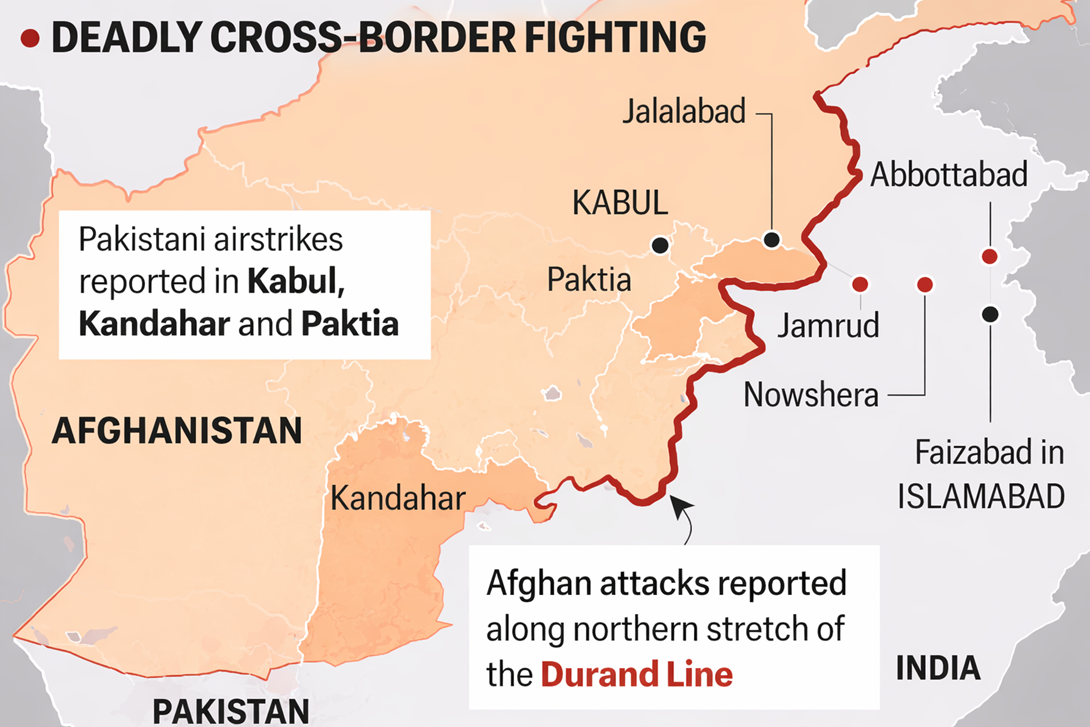
|
Historical Background: From Allies to Adversaries |
|
|
|
|
|
Major Causes of the Rift
(A) Durand Line Dispute
- The 2,640 km Durand Line (1893 colonial boundary) divides Pashtun tribal areas; no Afghan government recognises it as an international border.
- Key Issues: Taliban resist Pakistan's fencing (completed ~90% by 2025); frequent skirmishes at Torkham and Chaman crossings.
- Why Escalating?: Taliban view fencing as aggression; Pakistan sees unfenced borders as militant highways.
- Implications: Disrupts trade (~$2 billion annual bilateral trade), causes refugee flows, and fuels Pashtun nationalism.
(B) Rise of Tehreek-e-Taliban Pakistan (TTP)
- What is TTP?: Formed in 2007, ideologically aligned with Afghan Taliban but aims to overthrow Pakistan's government and impose Sharia.
- Core Problem: Pakistan accuses Afghan Taliban of sheltering TTP fighters in eastern Afghanistan; TTP attacks killed ~700 Pakistani security personnel in 2025.
- Taliban's Stance: Deny active support; advocate Pakistan-TTP dialogue; oppose Pakistani airstrikes as sovereignty violation.
- Ceasefire Collapse: Multiple ceasefires (latest in 2024) failed; TTP renewed offensive from Afghan soil.
- Implication: TTP's resurgence is a direct blowback of Pakistan's past Taliban support.
(C) Taliban's Strategic Autonomy
- Pakistan expected a dependent Kabul; instead, Taliban engaged independently with China (BRI investments), Russia (arms), Iran (water-sharing), and Central Asia (trade).
- India Factor: Taliban accepted Indian humanitarian aid, reopened Kabul mission (technical team), and expressed economic interest — viewed by Pakistan as a strategic encirclement.
(D) Economic & Refugee Pressures
- Afghanistan's economic collapse post-2021 led to refugee influx (~1.5 million Afghans in Pakistan).
- Trade disputes and border closures exacerbate mutual distrust.
Security Implications for Pakistan
- Terror Surge: TTP attacks in Khyber Pakhtunkhwa and Balochistan have increased 70% YoY, straining military resources.
- Economic Strain: Amid IMF bailout, security spending diverts funds from development.
- Political Instability: Public anger over border casualties fuels anti-government sentiment.
- Military Overstretch: Western border focus weakens eastern defences against India.
Regional & Global Dimensions
- China: Concerned about ETIM/Uyghur militants in Afghanistan; pushes Taliban for CPEC security but wary of TTP spillover.
- Iran: Tensions with Taliban over Helmand River water; Iran–Pakistan border clashes add complexity.
- USA: Post-withdrawal, limited leverage; focuses on counter-terrorism overflights but accuses Taliban of harbouring Al-Qaeda remnants.
- Central Asia: Fears extremism spillover; Tajikistan and Uzbekistan have conducted joint operations with Taliban against ISIS-K.
- Russia: Supplies arms to Taliban; views TTP as Pakistan's internal issue.
Implications for India
Opportunities:
- Engage Taliban on counter-terrorism (anti-LeT/JeM stance).
- Humanitarian leverage (aid, scholarships) for influence.
- Chabahar Port as alternative to Pakistan-dependent routes.
- Counter Pakistan's narrative in Kabul.
Risks:
- TTP–LeT/JeM linkages could revive anti-India terror from Afghan soil.
- Instability spills into Kashmir (radicalisation, arms flow).
- Refugee crisis affects India's neighbourhood policy.
India's Response: Maintain non-recognition but pragmatic engagement; monitor TTP via RAW; push SCO for regional counter-terror framework.
Theoretical Perspectives (Mains & Essay Fodder)
- Realism: Pakistan's "strategic depth" doctrine failed as Taliban prioritised self-interest over loyalty.
- Blowback Theory: State-sponsored proxies (Taliban) turn against sponsor (Pakistan via TTP).
- Security Dilemma: Pakistan's fencing provokes Taliban retaliation, escalating mutual mistrust.
- Proxy Autonomy Problem: Taliban evolved from Pakistani asset to independent actor.
Way Forward
- For Pakistan: Shift to diplomatic engagement; internal reconciliation with Pashtuns; border management talks.
- For Taliban: Crack down on TTP; recognise Durand Line for economic aid; seek UN legitimacy.
- For India: Calibrated Taliban engagement; strengthen CT cooperation with US/Russia; monitor refugee/terror flows.
- Regional Role: SCO/Afghan-led dialogue for stability.
Prelims
- Key terms: TTP (Tehreek-e-Taliban Pakistan), Durand Line, Khost Province, Quetta Shura.
- Historical: Taliban takeover (Aug 2021), Easter attacks linkage (NTJ).
- Related: India's Afghan policy (Chabahar, INSTC).
GS-2 (International Relations)
- Afghanistan–Pakistan rift and spillover for India.
- Neighbourhood First Policy challenges.
- SCO/SAARC role in regional stability.
GS-3 (Internal Security)
- TTP as proxy threat; cross-border terrorism.
- Link to Kashmir militancy.
Essay / Interview
- “Proxy politics in South Asia: From strategic asset to security liability.”
- “Can India turn Afghanistan's instability into diplomatic opportunity?”
1. With reference to the Pakistan–Afghan Taliban rift (February 2026), consider the following statements:
- Pakistan conducted airstrikes on TTP positions in Khost province, Afghanistan.
- The Durand Line is recognised by the Taliban as the international border with Pakistan.
- The Taliban called for dialogue to resolve the tensions.
Which of the statements given above is/are correct?
(a) 1 and 2 only
(b) 1 and 3 only
(c) 2 and 3 only
(d) 1, 2 and 3
Answer: (b)
2. The Tehreek-e-Taliban Pakistan (TTP) is primarily active in which region?
(a) Balochistan
(b) Khyber Pakhtunkhwa and FATA
(c) Sindh
(d) Punjab
Answer: (b)
3. Which of the following is NOT a cause of the Pakistan–Afghan Taliban rift?
(a) Durand Line border dispute
(b) Taliban’s sheltering of TTP militants
(c) Pakistan’s recognition of Taliban government
(d) Taliban’s independent foreign policy
Answer: (c)
4. The "strategic depth" doctrine in Pakistan's foreign policy refers to:
(a) Deepening ties with China
(b) Having a friendly regime in Afghanistan as a buffer against India
(c) Naval expansion in the Arabian Sea
(d) Economic integration with Central Asia
Answer: (b)
1. “The deterioration of Pakistan–Afghan Taliban relations from alliance to confrontation exemplifies the blowback of proxy politics in South Asia.” Critically examine the causes and implications of this rift for regional security. (15 marks / 250 words)
2. Discuss the impact of the Pakistan–Afghanistan border tensions on India's security concerns, particularly in relation to cross-border terrorism and regional stability. (10 marks / 150 words)
3. “India's engagement with the Afghan Taliban post-2021 is a pragmatic necessity rather than ideological endorsement.” Analyse this statement in the context of the evolving Pakistan–Taliban rift. (15 marks / 250 words)
4. Essay (250 marks) “Proxy Wars and Border Flames: The Pakistan–Afghanistan Rift and Its Ripple Effects on South Asian Geopolitics.”
Why in News?
On 28 February 2026, the Ministry of Statistics and Programme Implementation (MoSPI) released the Second Advance Estimates (SAE) for India's GDP in FY26, upgrading the economic growth projection to 7.6% from the First Advance Estimates (FAE) of 7.3% released in January 2026.
This revision is based on updated data series from the base year 2011–12 to a new base year, incorporating more accurate sectoral data, particularly from manufacturing and services. The upgrade comes amid a stronger outlook for the primary sector and a downward revision in nominal GDP size, which has positive implications for fiscal deficit management.
The new estimates were released by the National Statistical Office (NSO), and Chief Economic Adviser V. Anantha Nageswaran highlighted that the revision would "not only revise upward the growth for FY26 but also make its planned deficit reduction path a significant steeper one". This development is crucial as India aims for Viksit Bharat by 2047, with FY26 serving as a key transitional year.
Key Highlights from the Second Advance Estimates
- Real GDP Growth: Upgraded to 7.6% for FY26 (from 7.3% in FAE), driven by stronger performance in manufacturing (expected to grow at 8.5%) and construction (10.7%).
- Nominal GDP Revision: Downward revised to 6.9% growth (from 7.1%), leading to a smaller overall economy size. Nominal GDP for FY26 is now pegged at ₹3.33 lakh crore (down from ₹3.35 lakh crore in FAE).
- Sectoral Breakdown:
- Primary Sector: Growth revised upward to 2.8% (from 1.4%), reflecting better agricultural output.
- Secondary Sector: Manufacturing up to 8.5%; construction at 10.7%.
- Tertiary Sector: Services expected to see 7.3% growth, with trade, hotels, transport and communication grouping at 10.3%.
- Quarterly Trends:
- Q1 FY26: 8.2%
- Q2 FY26: 7.4%
- Q3 FY26: 6.5%
- Q4 FY26: 8.1% (projected)
- Fiscal Deficit Impact: Smaller nominal GDP means the overall size of the economy is reduced, making the government's fiscal deficit-to-GDP ratio lower than previously estimated (expected to aid in steeper deficit reduction).
- Base Year Shift: The new series uses an updated base year, incorporating changes in consumption patterns, production structures, and data sources for more accuracy.
Reasons for the Upgrade
- Better Data Incorporation: The SAE uses more comprehensive data from Q3 (October–December 2025), including corporate earnings, tax collections, and sectoral indices, leading to upward revisions in manufacturing and services.
- Stronger Primary Sector: Agricultural growth revised due to better monsoon estimates and crop yields.
- Construction Boom: Infrastructure push under schemes like PM Gati Shakti contributed to higher secondary sector growth.
- Services Resilience: Trade and communication sectors benefited from digital economy expansion and e-commerce recovery.
- Downward Nominal Revision: Due to lower inflation estimates and deflator adjustments, reducing the overall economy size but improving deficit ratios.
Implications for the Indian Economy
- Positive Signals:
- Indicates robust recovery post-COVID, with growth above 7% for the third consecutive year.
- Boosts investor confidence; likely to attract more FDI and FPI inflows.
- Supports RBI's monetary policy easing, with scope for interest rate cuts.
- Fiscal Space: Smaller nominal GDP allows steeper deficit reduction — FY26 deficit-to-GDP could be revised to ~5.1% (from 5.9%), aiding long-term debt sustainability.
- Challenges:
- Downward nominal revision means the absolute size of the economy is smaller, potentially impacting absolute spending on welfare and infrastructure.
- Primary sector slowdown (only 2.8%) highlights rural distress risks, especially with erratic monsoons.
- Services-led growth may not create enough jobs; unemployment remains a concern.
- Global Context: Amid US tariffs and slowing China, India's upgraded outlook positions it as a bright spot in emerging markets.
Broader Policy Context
- Aligns with Viksit Bharat @2047 vision, where sustained 7–8% growth is essential.
- Complements Union Budget 2026 focus on capex (₹11 lakh crore) and fiscal consolidation.
- RBI's role in monitoring corporate performance (linked to this data) will influence monetary policy review in April 2026.
Prelims
- Key terms: Second Advance Estimates (SAE), Nominal vs Real GDP, Deflator, Fiscal Deficit-to-GDP.
- Data: FY26 growth 7.6%, Nominal GDP ₹3.33 lakh crore.
- Related: NSO, MoSPI, CEA V. Anantha Nageswaran.
GS-3 (Economy)
- GDP estimation methodology (base year shift, advance estimates).
- Sectoral contributions to growth.
- Fiscal policy implications (deficit reduction).
GS-3 (Indian Economy)
- Post-COVID recovery trends.
- Challenges of services-led growth.
Essay / Interview
- “India’s GDP revisions: A story of resilience or statistical adjustment?”
- “Sustained high growth: The key to Viksit Bharat amid global uncertainties.”
1. With reference to the Second Advance Estimates for FY26 released in February 2026, consider the following statements:
- Real GDP growth has been upgraded to 7.6% from 7.3% in the First Advance Estimates.
- Nominal GDP has been revised downward to 6.9% growth.
- The primary sector growth has been revised upward to 2.8%.
Which of the statements given above is/are correct?
(a) 1 only
(b) 1 and 2 only
(c) 2 and 3 only
(d) 1, 2 and 3
Answer: (d)
2. The downward revision in nominal GDP for FY26 implies:
(a) Higher growth in real terms
(b) Smaller overall economy size, aiding fiscal deficit-to-GDP ratio reduction
(c) Increased inflation estimates
(d) No impact on government borrowing
Answer: (b)
3. Which sector is expected to grow at 10.7% in FY26 according to the Second Advance Estimates?
(a) Agriculture
(b) Manufacturing
(c) Construction
(d) Services
Answer: (c)
4. The Second Advance Estimates for GDP are released by:
(a) Reserve Bank of India (RBI)
(b) National Statistical Office (NSO)
(c) NITI Aayog
(d) Finance Commission
Answer: (b)
1. “The upgrade in FY26 GDP growth to 7.6% in the Second Advance Estimates reflects India's resilient recovery but masks underlying sectoral imbalances.” Critically analyse the key revisions and their implications for fiscal policy and economic planning. (15 marks / 250 words)
2. Discuss the methodology of GDP estimation in India and the significance of advance estimates in shaping monetary and fiscal policy. (10 marks / 150 words)
3. “A downward revision in nominal GDP size provides fiscal headroom but reduces the absolute scale of the economy.” In the context of FY26 estimates, examine the statement and its impact on government schemes and investment. (15 marks / 250 words)
4. Essay (250 marks) “India’s Growth Story in FY26: From Estimates to Economic Reality – Challenges and Opportunities for Viksit Bharat.”
Why in News?
On 25 February 2026, Pakistan conducted major airstrikes on Afghan Taliban positions in Khost province (Afghanistan), marking one of the most aggressive cross-border actions since the Taliban takeover in 2021.
The Afghan Taliban retaliated with artillery and mortar fire on Pakistani border areas, leading Pakistan's Defence Minister Khawaja Asif to warn of an "open war" if attacks continue. In a surprising turn, the Taliban government called for "dialogue" to resolve the crisis, even as casualties mounted on both sides.
This escalation is rooted in Pakistan's accusations that Afghanistan is sheltering Tehreek-e-Taliban Pakistan (TTP) militants, who have launched deadly attacks on Pakistani soil. The incident highlights the fragile state of Afghanistan–Pakistan relations and has broader implications for regional stability, including India's security concerns over cross-border terrorism.
Key Facts & Developments
- Pakistan's Airstrikes: Targeted TTP hideouts in Khost; Pakistan claims the strikes were "precision" and killed several militants. Afghan sources report civilian casualties, including women and children.
- Afghan Retaliation: Taliban forces fired artillery on Pakistani border posts in Kurram and North Waziristan districts, causing casualties among Pakistani soldiers.
- Casualties: At least 10 killed in Pakistani strikes (Afghan claim); Pakistan reports 4 soldiers killed in retaliation.
- Taliban's Response: Taliban spokesperson Zabihullah Mujahid condemned the strikes as "unilateral aggression" but called for "dialogue and diplomatic channels" to resolve the issue.
- Pakistan's Stance: Defence Minister Asif said the strikes were "defensive" and warned that Pakistan "will not hesitate to take further action" if TTP attacks from Afghan soil continue.
Background & Root Causes
- Historical Rivalry: The Durand Line border has been a flashpoint since 1893; Afghanistan does not recognise it as an international boundary.
- Post-2021 Taliban Takeover: Pakistan initially welcomed the Taliban but has since accused them of harbouring TTP militants, who have intensified attacks on Pakistani forces (over 700 killed in 2025 alone).
- TTP Factor: TTP (Tehreek-e-Taliban Pakistan) is a banned militant group seeking to overthrow the Pakistani government; it operates from Afghan soil with alleged Taliban support.
- Recent Escalations: In December 2025, Pakistan conducted limited airstrikes; this is the third major cross-border incident in six months.
- Regional Context: The conflict occurs amid broader instability in South Asia, including India's concerns over TTP's links with other terror groups like Lashkar-e-Taiba.
Implications for Regional Stability & India
- For Afghanistan–Pakistan Relations: Risks full-scale border war; could destabilise the Durand Line, leading to refugee flows and humanitarian crisis.
- For South Asia: Escalation could embolden other militant groups, worsening security in the region.
- For India:
- Security Threat: TTP has historical links with anti-India groups; any instability in Afghanistan–Pakistan border areas could spill over into Kashmir or Punjab.
- Diplomatic Opportunity: India can position itself as a stabilising force, strengthening ties with the Taliban on counter-terrorism while monitoring Pakistan's response.
- Economic Angle: Disruption in the region affects trade routes like INSTC and India's access to Central Asia via Afghanistan.
- Strategic Response: India should push for UN/SCO mediation to prevent escalation; continue intelligence sharing with Afghanistan on TTP.
Prelims
- Key terms: TTP (Tehreek-e-Taliban Pakistan), Durand Line, Khost Province.
- Historical fact: Taliban takeover of Afghanistan (August 2021).
- Related: India's Afghanistan policy (evacuation, aid, Taliban engagement).
GS-2 (International Relations)
- India-Pakistan-Afghanistan triangle.
- Neighbourhood First Policy and managing cross-border terrorism.
- Role of regional forums like SCO, SAARC.
GS-3 (Internal Security)
- TTP as a threat to regional stability.
- Linkages between TTP and anti-India groups (LeT, JeM).
- Border management challenges in South Asia.
Essay / Interview
- “Cross-border terrorism and fragile borders: The Afghanistan–Pakistan conflict's spillover risks for India.”
- “Can dialogue triumph over drones? Lessons from the latest Afghanistan–Pakistan escalation.”
1. With reference to the recent escalation between Pakistan and Afghanistan (February 2026), consider the following statements:
- Pakistan conducted airstrikes on TTP positions in Khost province, Afghanistan.
- The Afghan Taliban retaliated with artillery fire on Pakistani border posts.
- The Durand Line is recognised by Afghanistan as the international border with Pakistan.
Which of the statements given above is/are correct?
(a) 1 and 2 only
(b) 2 and 3 only
(c) 1 and 3 only
(d) 1, 2 and 3
Answer: (a)
2. The Tehreek-e-Taliban Pakistan (TTP) primarily seeks to:
(a) Establish an independent state in Kashmir
(b) Overthrow the Pakistani government and impose Sharia law
(c) Support the Afghan Taliban against NATO
(d) Negotiate peace with India
Answer: (b)
3. Which of the following is the primary cause of the latest Afghanistan–Pakistan border tensions?
(a) Water sharing disputes
(b) Afghanistan's sheltering of TTP militants
(c) Trade embargo by Pakistan
(d) Refugee repatriation issues
Answer: (b)
4. The Afghan Taliban's response to Pakistan's airstrikes was:
(a) Immediate declaration of war
(b) Call for dialogue and diplomatic resolution
(c) Request for UN intervention
(d) Alliance with India against Pakistan
Answer: (b)
1. “The escalation between Pakistan and Afghanistan in February 2026 underscores the fragility of South Asian borders and the persistent threat of cross-border terrorism.” Discuss the implications for India's security and foreign policy. (15 marks / 250 words)
2. Analyse the role of the Tehreek-e-Taliban Pakistan (TTP) in straining Afghanistan–Pakistan relations. How does this impact regional stability in South Asia? (10 marks / 150 words)
3. “Dialogue amid drones: The Afghan Taliban's call for talks with Pakistan reflects pragmatic survival instincts rather than genuine reconciliation.” Critically examine this statement. (15 marks / 250 words)
4. Essay (250 marks) “Cross-Border Fires and Fragile Frontiers: The Afghanistan–Pakistan Conflict's Ripple Effects on South Asian Security and India's Neighbourhood Diplomacy.”
Why in News?
- On 28 February 2026, Prime Minister Narendra Modi is set to launch India's first nationwide Human Papillomavirus (HPV) vaccination programme aimed at protecting 14-year-old girls from cervical cancer.
- The launch will be from New Delhi, with all States and Union Territories joining virtually.
- This voluntary, free-of-cost initiative marks a major step in India's fight against cervical cancer, which is the second most common cancer among women in India (accounting for ~18% of female cancers, with ~1.23 lakh new cases and ~77,000 deaths annually as per GLOBOCAN 2020 data).
- The programme aligns with the World Health Organization's (WHO) 90-70-90 strategy for cervical cancer elimination by 2030 (90% girls vaccinated by age 15, 70% women screened by 35 and 45, 90% treated).
- It comes amid growing concerns over rising cervical cancer incidence due to low screening rates (only 1–2% women screened regularly in India) and limited access to preventive vaccines.
Key Features of the Programme
- Target Group: Girls aged 9–14 years (focus on 14-year-olds in the initial phase; school-going and out-of-school girls).
- Vaccine: Gardasil (quadrivalent HPV vaccine) — protects against HPV types 6, 11, 16 and 18.
- Types 16 and 18 cause ~70% of cervical cancers.
- Types 6 and 11 cause genital warts.
- Dosage & Delivery: Two-dose schedule (0 and 6 months); administered at government health facilities, schools, and outreach camps.
- Cost: Completely free, funded by the Central Government.
- Consent: Parental/guardian consent required; voluntary participation.
- Indigenous Angle: The Health Ministry has indicated that a made-in-India HPV vaccine (Cervavac by Serum Institute) may be introduced in future phases for cost-effectiveness and self-reliance.
Background & Rationale
- Cervical Cancer Burden: India accounts for ~25% of global cervical cancer deaths. It is caused primarily by persistent HPV infection, with risk factors including early marriage, multiple partners, tobacco use, and low hygiene.
- Global Context: Over 50 countries have national HPV vaccination programmes (e.g., Australia has nearly eliminated cervical cancer through vaccination + screening).
- India's Past Efforts: Pilot programmes in Sikkim and Punjab (2016–18) showed high acceptance; delayed due to COVID-19 and vaccine hesitancy concerns.
- NEP & Health Linkage: Aligns with National Education Policy 2020's focus on health education and Sustainable Development Goal 3 (Good Health & Well-Being).
- Economic Case: Preventing cervical cancer saves ~₹2,000 crore annually in treatment costs (per ICMR estimates).
Significance for India
- Public Health Milestone: Could reduce cervical cancer incidence by 70–90% in vaccinated cohorts over 20–30 years.
- Gender Equity: Targets adolescent girls, addressing a disease that disproportionately affects women from lower socio-economic groups.
- Economic Benefits: Reduces healthcare burden, improves workforce participation for women, and supports Viksit Bharat by 2047.
- Global Leadership: Positions India as a leader in preventive healthcare in the Global South, aligning with G20 commitments on health equity.
- Link to Other Initiatives: Complements Ayushman Bharat for cancer screening and PM-JAY for treatment.
Challenges & Criticisms
- Vaccine Hesitancy: Misinformation linking HPV vaccine to infertility or promiscuity (stemming from 2009–10 trials controversies).
- Logistics: Reaching out-of-school girls in rural areas; cold chain maintenance for vaccines.
- Equity Issues: Ensuring coverage in low-income, remote, and minority communities.
- Long-Term Monitoring: Need for post-vaccination surveillance for efficacy and adverse effects.
- Criticism: Some Opposition parties argue the focus on 14-year-olds is narrow; demand inclusion of boys (for herd immunity) and older women.
Prelims
- Key terms: HPV (Human Papillomavirus), Gardasil vaccine, Cervical cancer, WHO 90-70-90 strategy.
- Data: Cervical cancer – 1.23 lakh new cases/year in India; ~70% caused by HPV 16/18.
- Related Schemes: Ayushman Bharat, PM-JAY, NEP 2020 (health education).
GS-2 (Health & Governance)
- Preventive healthcare as a public good.
- Role of vaccination in disease elimination (link to polio, COVID-19).
- Gender justice in health policy.
GS-3 (Science & Technology)
- Vaccine technology (quadrivalent vs. bivalent).
- India's vaccine self-reliance (Cervavac).
GS-1 (Society)
- Socio-economic determinants of women's health.
- Impact of cancer on demographic dividend.
Essay / Interview
- “Preventive vaccination: India's weapon against non-communicable diseases like cervical cancer.”
- “How can India achieve cervical cancer elimination by 2030 while addressing vaccine hesitancy and equity challenges?”
1. With reference to the nationwide HPV vaccination programme launched in February 2026, consider the following statements:
- It targets girls aged 9–14 years and uses the Gardasil quadrivalent vaccine.
- The programme is mandatory and will be administered only in hospitals.
- Cervical cancer is the second most common cancer among Indian women, with ~70% cases caused by HPV types 16 and 18.
Which of the statements given above is/are correct?
(a) 1 and 2 only
(b) 1 and 3 only
(c) 2 and 3 only
(d) 1, 2 and 3
Answer: (b)
2. The WHO's 90-70-90 strategy is related to:
(a) Tuberculosis elimination
(b) Cervical cancer elimination
(c) HIV/AIDS control
(d) Polio eradication
Answer: (b)
3. Which of the following is NOT a risk factor for cervical cancer?
(a) Early marriage and multiple sexual partners
(b) Tobacco use and poor hygiene
(c) HPV types 16 and 18 infection
(d) Excessive vaccination in childhood
Answer: (d)
4. The HPV vaccination programme in India is funded by:
(a) World Health Organization
(b) Central Government (free of cost)
(c) State Governments
(d) Private pharmaceutical companies
Answer: (b)
1. “The launch of the nationwide HPV vaccination programme in February 2026 is a landmark step towards preventive healthcare and gender equity in India.” Discuss its significance, challenges, and potential impact on cervical cancer elimination. (15 marks / 250 words)
2. Analyse the role of vaccination drives in addressing non-communicable diseases like cervical cancer. How does the HPV programme align with India's SDG commitments? (10 marks / 150 words)
3. “Vaccine hesitancy remains a major barrier to public health initiatives in India.” In the context of the HPV vaccination drive, suggest strategies to overcome misinformation and ensure high uptake. (15 marks / 250 words)
4. Essay (250 marks) “Preventive Healthcare as the Pillar of Viksit Bharat: The Role of HPV Vaccination in Combating Cervical Cancer and Empowering Women.”
Why in News?
On 28 February 2026, Canadian Prime Minister Mark Carney arrived in Mumbai for a four-day official visit to India — his first major international trip since assuming office. The visit aims to reset and strengthen bilateral ties amid global geopolitical shifts, including the Russia-Ukraine war's energy fallout, U.S. protectionism, and Indo-Pacific tensions.
Carney's itinerary includes meetings with External Affairs Minister S. Jaishankar, business leaders, and possibly Prime Minister Narendra Modi. The focus will be on trade, energy (fossil fuels, nuclear), climate cooperation, and maritime security. This comes after a period of strained relations due to the 2023 diplomatic row over the killing of Hardeep Singh Nijjar, but signals a pragmatic thaw driven by mutual economic interests.
Key Details of the Visit
- Duration & Schedule: Four-day visit starting in Mumbai; will also travel to New Delhi.
- Key Meetings:
- With EAM S. Jaishankar: Discussions on comprehensive economic partnership agreement (CEPA) negotiations, fossil fuel cooperation, nuclear energy, and maritime security.
- With business leaders: Focus on investment opportunities in clean energy, technology, and infrastructure.
- Expected Outcomes: Signing of MoUs on energy cooperation, trade facilitation, and possibly a joint working group on climate and security.
- Contextual Backdrop: Canada seeks to diversify energy sources away from Russia; India looks for reliable partners in clean tech and nuclear fuel amid its 2070 net-zero goal.
Background: India-Canada Relations
- Historical Ties: Strong people-to-people links (over 1.8 million Indian-origin Canadians); trade worth ~$8–10 billion in FY25.
- Recent Strains: 2023 diplomatic crisis over Nijjar killing led to expulsion of diplomats and trade talks pause.
- Post-2023 Thaw: Relations improved after 2024 elections in both countries; focus shifted to economic pragmatism.
- Economic Snapshot: Canada is a key source of potash, lentils, and uranium for India; India exports pharma, textiles, and gems to Canada.
- Strategic Angle: Both are G20 members; Canada pushes for CPTPP inclusion for India; shared concerns over China in the Indo-Pacific.
Areas of Focus During the Visit
- Trade & CEPA: Negotiations for a Comprehensive Economic Partnership Agreement stalled since 2023; aim to resume for tariff reductions on goods like lentils, uranium, and pharma.
- Energy Cooperation: Canada offers expertise in nuclear energy (CANDU reactors); discussions on fossil fuel imports and green hydrogen.
- Climate & Clean Tech: Joint initiatives on renewable energy, carbon capture, and sustainable mining (Canada is a potash leader).
- Maritime Security: Cooperation on Indo-Pacific strategy, countering piracy, and securing sea lanes (relevant for India's energy imports).
- People-to-People: Visa facilitation, student mobility (over 2 lakh Indian students in Canada), and diaspora engagement.
Significance for India
- Economic Boost: Could unlock $5–10 billion in additional trade/investment; access to Canadian tech for India's green transition.
- Energy Security: Diversify nuclear fuel sources (Canada supplies ~10% of India's uranium needs).
- Strategic Depth: Strengthens India's multi-alignment (balancing US, Russia, China ties); Canada as a G7 partner adds weight to India's global voice.
- Challenges: Lingering trust deficit over Nijjar case; Canada’s vocal stance on human rights could create friction.
- Global Context: Amid US tariffs and EU green regulations, India-Canada ties offer a stable North American anchor.
Prelims
- Key terms: CEPA (Comprehensive Economic Partnership Agreement), CANDU reactors, Indo-Pacific strategy.
- Bilateral facts: India-Canada trade ~$8–10 billion; 1.8 million PIOs in Canada.
- Recent events: 2023 Nijjar crisis, 2024 election thaws.
GS-2 (International Relations)
- India-Canada bilateral ties: From strain to reset.
- Multi-alignment policy (G7 partner like Canada).
- Diaspora diplomacy and economic partnerships.
GS-3 (Economy)
- Trade diversification and CEPA negotiations.
- Energy security (nuclear + renewables).
- Impact on India's green transition.
GS-3 (Science & Technology)
- Nuclear cooperation (CANDU tech).
- Clean energy collaboration.
Essay / Interview
- “From Diplomatic Chill to Economic Thaw: India-Canada Relations in a Multipolar World.”
- “How can India leverage its diaspora and energy needs to strengthen ties with G7 nations like Canada?”
1. With reference to Canadian PM Mark Carney’s visit to India in February 2026, consider the following statements:
- The visit focuses on resuming Comprehensive Economic Partnership Agreement (CEPA) negotiations.
- Canada is a major supplier of uranium and potash to India.
- The visit is Carney's first major international trip since assuming office.
Which of the statements given above is/are correct?
(a) 1 only
(b) 1 and 2 only
(c) 2 and 3 only
(d) 1, 2 and 3
Answer: (d)
2. The Comprehensive Economic Partnership Agreement (CEPA) negotiations between India and Canada were stalled in 2023 due to:
(a) Trade tariffs
(b) Diplomatic row over the killing of Hardeep Singh Nijjar
(c) Energy disputes
(d) Climate policy differences
Answer: (b)
3. Which of the following is NOT a key area of focus during the Canada-India discussions in February 2026?
(a) Fossil fuel cooperation
(b) Nuclear energy
(c) Maritime security
(d) Joint military bases
Answer: (d)
4. CANDU reactors are associated with which country's nuclear technology?
(a) United States
(b) France
(c) Canada
(d) Russia
Answer: (c)
1. “The visit of Canadian PM Mark Carney to India in February 2026 represents a pragmatic reset in bilateral relations after the 2023 diplomatic crisis.” Discuss the key areas of cooperation and the challenges that remain in India-Canada ties. (15 marks / 250 words)
2. Analyse the role of diaspora diplomacy in strengthening India-Canada relations. How can India leverage its 1.8 million PIOs in Canada for economic and strategic gains? (10 marks / 150 words)
3. “In a multipolar world, India must balance its relations with G7 nations like Canada while safeguarding its strategic autonomy.” Critically examine this statement in the context of energy security and trade partnerships. (15 marks / 250 words)
4. Essay (250 marks) “From Diplomatic Strain to Strategic Gain: The Evolution of India-Canada Relations in the 21st Century.”
Why in News?
- On 28 February 2026, the Meghalaya government issued an urgent advisory urging people to avoid crowded places and follow strict protocols in response to suspected cases of meningococcal bacterial infection at the Assam Regiment Centre in Shillong.
- The Health and Family Welfare Department, through Principal Secretary Bram Deka, announced intensified surveillance measures, including case investigation, contact tracing, lab review, and public awareness campaigns.
- This comes after one or more than 30 trainees at the centre were suspected of the infection, with no new cases reported in the past few days.
- The alert highlights vulnerabilities in crowded institutional settings (like military barracks) and the need for rapid public health response in India's Northeast, a region prone to infectious disease outbreaks due to climate, terrain, and connectivity issues.
Key Facts of the Outbreak & Response
- Suspected Cases: Over 30 trainees at the Assam Regiment Centre in Shillong (East Khasi Hills district) showed symptoms of meningococcal infection (high fever, headache, stiff neck, nausea, sensitivity to light).
- No New Cases: As per the latest update, no additional suspected cases in the past few days; the outbreak appears contained.
- Government Advisory:
- Avoid crowded places.
- Practice hand hygiene, respiratory etiquette (cover cough/sneeze).
- Seek immediate medical help for symptoms.
- Surveillance Measures:
- Case Investigation: Active epidemiological probe by the East Khasi Hills District Surveillance Unit.
- Contact Tracing: Monitoring close contacts and implementing preventive interventions.
- Lab Review: Enhanced testing and analysis to confirm meningococcal strain (Neisseria meningitidis).
- Public Awareness: Campaigns to educate on symptoms and prevention.
- Broader Context: Meningococcal disease is highly contagious in crowded environments; vaccination (MenACWY) is recommended for high-risk groups like military personnel.
Background on Meningococcal Disease
- Causative Agent: Caused by the bacterium Neisseria meningitidis (meningococcus), which spreads through respiratory droplets.
- Symptoms: Sudden high fever, severe headache, stiff neck, rash, confusion — can lead to meningitis or septicaemia (blood poisoning).
- Transmission: Close contact in crowded settings (barracks, hostels, schools); not as contagious as common cold but fatal if untreated (10–15% mortality).
- Vaccine Availability: Quadrivalent vaccine (MenACWY) protects against major strains; not part of India's Universal Immunisation Programme (UIP) but recommended for travellers/military.
- India's Burden: Annual cases ~2,000–3,000 (ICMR data); outbreaks common in North and Northeast during winter/dry seasons.
Implications & Challenges
- Public Health Impact: Rapid spread in military/training centres could lead to wider community transmission if not contained; highlights gaps in institutional hygiene and vaccination protocols.
- Economic Angle: Outbreaks disrupt training/operations; treatment costs high (antibiotics like ceftriaxone, hospitalisation).
- Regional Vulnerability: Northeast's humid climate, poor connectivity, and crowded urban pockets make it prone to vector-borne/respiratory outbreaks (e.g., Japanese Encephalitis, COVID-19).
- Policy Lesson: Reinforces need for stronger Integrated Disease Surveillance Programme (IDSP) and routine vaccination for high-risk groups.
- Challenges: Low awareness, delayed reporting, antibiotic resistance; climate change may increase outbreak frequency.
Prelims
- Key terms: Meningococcal disease (Neisseria meningitidis), East Khasi Hills, Assam Regiment Centre, IDSP.
- Vaccine: MenACWY (quadrivalent meningococcal vaccine).
- Related: UIP, NVBDCP (though meningococcal is bacterial, not vector-borne).
GS-2 (Health & Governance)
- Public health surveillance and response mechanisms.
- Centre-State coordination in disease outbreaks (Meghalaya's quick advisory).
- Role of advisories in preventive healthcare.
GS-3 (Science & Technology / Disaster Management)
- Bacterial infections vs. viral; vaccine technology.
- Outbreak management in institutional settings.
GS-1 (Geography / Society)
- Disease patterns in Northeast India (humidity, crowding).
- Impact on vulnerable groups (military trainees).
Essay / Interview
- “Public health advisories: From reactive alerts to proactive prevention in India.”
- “How can India strengthen disease surveillance in remote and crowded institutional settings?”
1. With reference to the recent meningococcal disease alert in Meghalaya (February 2026), consider the following statements:
- The suspected cases were reported among trainees at the Assam Regiment Centre in Shillong.
- Meningococcal disease is caused by the bacterium Neisseria meningitidis.
- The government has advised avoiding crowded places and practicing hand hygiene.
Which of the statements given above is/are correct?
(a) 1 and 2 only
(b) 2 and 3 only
(c) 1 and 3 only
(d) 1, 2 and 3
Answer: (d)
2. The meningococcal vaccine commonly recommended for high-risk groups protects against how many strains?
(a) One (monovalent)
(b) Two (bivalent)
(c) Four (quadrivalent)
(d) Five (pentavalent)
Answer: (c)
3. Which of the following is NOT a symptom of meningococcal infection?
(a) High fever and stiff neck
(b) Rash and sensitivity to light
(c) Persistent cough and chest pain
(d) Headache and confusion
Answer: (c)
4. The Integrated Disease Surveillance Programme (IDSP) in India is primarily aimed at:
(a) Vaccination drives
(b) Early detection and response to outbreaks
(c) Hospital infrastructure development
(d) Medical education reform
Answer: (b)
1. “The meningococcal disease alert in Meghalaya highlights the vulnerabilities of institutional settings to infectious outbreaks.” Discuss the challenges in outbreak management in such environments and suggest measures to strengthen public health surveillance in India. (15 marks / 250 words)
2. Examine the role of advisories and protocols in preventing the spread of bacterial infections like meningococcal disease. How effective are they in a diverse country like India? (10 marks / 150 words)
3. “Climate and crowding make Northeast India a hotspot for infectious diseases.” In the context of the recent Meghalaya alert, analyse the statement and discuss the need for region-specific public health strategies. (15 marks / 250 words)
4. Essay (250 marks) “From Surveillance to Safety: India's Battle Against Infectious Diseases in the Post-Pandemic Era.”
Why in News?
A recent peer-reviewed research paper (published in early 2026 in a leading ecological journal) has issued a stark warning: climate change is projected to drastically shrink the habitat of the Nilgiri Wood Pigeon (Columba elphinstonii) — an endemic species of the Western Ghats — confining it to a few isolated high-elevation pockets by the end of the century (2100).
The study, based on species distribution modelling under multiple IPCC climate scenarios (RCP 4.5 and RCP 8.5), predicts:
- Loss of 60–85% of current suitable habitat under moderate to high-emission pathways.
- Altitudinal upward shift of suitable climate zones by 400–800 metres.
- Increased fragmentation and isolation of remaining populations, raising risks of local extinction.
This finding has renewed focus on the vulnerability of Western Ghats endemics and the urgent need for climate-resilient conservation planning.
Key Findings of the 2026 Research Paper
- Habitat Loss Projection:
- Under RCP 4.5 (moderate emissions): ~60–65% loss of climatically suitable habitat by 2070–2100.
- Under RCP 8.5 (high emissions): ~80–85% loss; most current sites become unsuitable.
- Altitudinal Shift: Suitable climate envelope moves upward by 400–800 m → many current mid-elevation populations will lose habitat.
- Fragmentation Risk: Remaining patches will be small and isolated → increased inbreeding, genetic drift, and local extinction risk.
- Current Strongholds at Risk: Nilgiri Biosphere Reserve, Anamalai Tiger Reserve, Silent Valley, Agasthyamalai — all projected to lose large portions of suitable area.
- Conservation Urgency: Authors recommend:
- Immediate protection of high-elevation shola forests.
- Corridor connectivity between isolated populations.
- Assisted migration / ex-situ breeding if habitat loss accelerates.
Broader Context & Significance
- Western Ghats Endemics at Risk: Over 30% of Western Ghats bird species are endemic; many are habitat specialists vulnerable to climate shifts.
- Climate Refugia Concept: High-altitude shola forests act as climate refugia, but even these are projected to shrink.
- Link to Global Goals:
- Aligns with India’s Nationally Determined Contributions (NDCs) and Long-Term Low Emission Development Strategy (LT-LEDS).
- Relevant to UNFCCC, CBD, Ramsar, and IUCN Red List assessments.
- Comparison: Similar projections exist for Nilgiri Tahr, Lion-tailed Macaque, Nilgiri Langur — all face altitudinal squeeze.
Conservation Status & Efforts
- IUCN: Least Concern (but population trend decreasing; uplisted risk likely in next assessment).
- WPA 1972: Schedule I — absolute protection.
- Key Protected Areas: Mudumalai, Mukurthi, Silent Valley, Anamalai, Periyar, Agasthyavanam.
- Current Initiatives:
- Western Ghats Biodiversity Conservation Project.
- Shola ecosystem restoration under CAMPA funds.
- Bird monitoring under IBIS (Indian Birding Initiative for Sustainability).
- Gaps: No dedicated species recovery plan for Nilgiri Wood Pigeon; climate-adaptive management still nascent.
Prelims
- Endemic species of Western Ghats
- IUCN status: Least Concern (but declining)
- Habitat: Shola-grassland mosaic, wet evergreen forests
- Altitude: 700–2,250 m
- Feeding guild: Frugivorous canopy forager
- Related: Nilgiri Biosphere Reserve, Anamalai Tiger Reserve
GS-3 (Environment & Ecology)
- Climate change impact on endemic species & altitudinal shifts
- Habitat fragmentation & metapopulation dynamics
- Western Ghats biodiversity hotspot & UNESCO World Heritage status
GS-1 (Geography)
- Shola ecosystem, biogeography of Western Ghats
- Climate refugia concept
GS-3 (Disaster Management / Agriculture)
- Link between climate change, biodiversity loss, and ecosystem services (seed dispersal by frugivores)
Essay / Interview
- “Climate change is silently redrawing India’s biodiversity map — from Western Ghats to Himalayas.”
- “Endemic species as climate sentinels: What the Nilgiri Wood Pigeon tells us about India’s ecological future.”
1. With reference to the Nilgiri Wood Pigeon, consider the following statements:
- It is endemic to the Western Ghats and listed as Least Concern by IUCN.
- Its distinctive field mark is a checkerboard pattern on the nape.
- It primarily inhabits low-elevation dry deciduous forests.
Which of the statements given above is/are correct?
(a) 1 and 2 only
(b) 2 and 3 only
(c) 1 and 3 only
(d) 1, 2 and 3
Answer: (a)
2. The Nilgiri Wood Pigeon is mainly threatened by which of the following factors?
- Hunting and poaching
- Habitat loss due to plantations and infrastructure
- Climate change-induced altitudinal habitat shift
- Predation by invasive species
Select the correct answer using the code below:
(a) 1 and 2 only
(b) 1, 2 and 3 only
(c) 2 and 3 only
(d) 1, 2, 3 and 4
Answer: (b)
3. Which of the following protected areas is a key habitat for the Nilgiri Wood Pigeon?
(a) Kaziranga National Park
(b) Silent Valley National Park
(c) Sundarbans National Park
(d) Gir National Park
Answer: (b)
4. The recent research warning about the Nilgiri Wood Pigeon’s habitat loss is primarily linked to:
(a) Deforestation alone
(b) Climate change and altitudinal shift of suitable climate zones
(c) Hunting and poaching
(d) Invasive plant species
Answer: (b)
1. “Climate change is emerging as the most insidious long-term threat to endemic species of the Western Ghats.” In light of the latest research on the Nilgiri Wood Pigeon, critically examine the projected impacts and suggest adaptive conservation strategies for montane biodiversity hotspots. (15 marks / 250 words)
2. Discuss the ecological significance of frugivorous birds like the Nilgiri Wood Pigeon in the Western Ghats ecosystem. How does climate-induced habitat fragmentation threaten seed dispersal services and forest regeneration? (10 marks / 150 words)
3. “Protecting isolated high-elevation refugia is now the most critical strategy for conserving climate-vulnerable species in India.” Evaluate this statement with reference to the Nilgiri Wood Pigeon and similar Western Ghats endemics. (15 marks / 250 words)
4. Essay (250 marks) “Silent Sholas, Vanishing Wings: Climate Change and the Future of Western Ghats Endemics.”
Why in News?
Between 24–26 February 2026, the Defence Research and Development Organisation (DRDO) successfully conducted three successive flight-trials of the Very Short-Range Air Defence System (VSHORADS) from the Integrated Test Range (ITR), Chandipur, off the Odisha coast.
All three trials met all mission objectives, demonstrating the system’s reliability in engaging low-flying aerial threats (helicopters, slow-moving fixed-wing aircraft, UAVs, and cruise missiles) under day and night conditions.
The trials validated critical technologies, including the miniaturized Reaction Control System (RCS) and integrated avionics, marking a major milestone in India’s quest for a fully indigenous Man-Portable Air Defence System (MANPADS) to replace ageing Igla systems.
Key Highlights of the Trials
- Platform: Man-portable shoulder-launched missile system.
- Range & Altitude: Maximum engagement range ~8 km, altitude up to 4.5 km.
- Guidance: Imaging Infrared (IIR) seeker with fire-and-forget capability.
- Novel Technologies Validated:
- Miniaturized Reaction Control System (RCS) using thrusters for precise attitude control and steering.
- Fully integrated avionics package.
- Dual-mode fuse (proximity + impact).
- Test Scenarios: Day & night launches, low-altitude manoeuvring targets, high off-boresight capability.
- Outcome: All three missiles successfully intercepted the targets; system readiness level now very high for user trials.
Strategic & Operational Significance
- Replacement of Igla: Current inventory of Russian Igla MANPADS is ageing; VSHORADS will provide a modern, indigenous alternative.
- Tri-Service Requirement: Designed to meet needs of Indian Army, Navy (ship-borne point defence), and Air Force (base air defence).
- Make in India & Atmanirbhar Bharat: Developed by Research Centre Imarat (RCI), Hyderabad in collaboration with other DRDO labs and Indian industry partners (Bharat Dynamics Ltd is production agency).
- Export Potential: Cost-competitive MANPADS with proven seeker and RCS technology can target friendly nations in Southeast Asia, Africa, and Latin America.
- Threat Environment: Addresses low, slow, small (LSS) aerial threats — especially drones and loitering munitions — that have proliferated in modern warfare (seen in Ukraine, Nagorno-Karabakh, Gaza).
|
Comparison with Global MANPADS |
||||||||||||||||||||||||||||||||||||
|
VSHORADS matches or exceeds global benchmarks in range and seeker technology while being fully indigenous.
Next Steps & Timeline
- User Trials: Indian Army, Navy, and Air Force to conduct joint user trials in 2026–27.
- Induction: Likely induction by 2027–28 (subject to successful user trials and production ramp-up).
- Production Partner: Bharat Dynamics Limited (BDL) will lead serial production.
- Variants Planned: Vehicle-mounted (multi-tube launcher) and naval versions.
Prelims
- Full form: VSHORADS → Very Short-Range Air Defence System
- Developer: Research Centre Imarat (RCI), DRDO
- Test Range: Integrated Test Range (ITR), Chandipur, Odisha
- Key technology: Miniaturized Reaction Control System (RCS), Imaging Infrared (IIR) seeker
- Related systems: Igla, Stinger, Mistral
GS-3 (Defence & Technology)
- Indigenous defence production under Atmanirbhar Bharat.
- MANPADS role in modern layered air defence.
- Counter to drone/loitering munition threats.
GS-3 (Internal Security)
- Protection of forward posts, convoys, and VVIPs from low-level aerial threats.
GS-2 (Governance)
- Role of DRDO–industry partnership in strategic capability building.
Essay / Interview
- “Indigenous defence technologies are the backbone of strategic autonomy in a multipolar world.”
- “From import dependence to export potential: The journey of India’s Very Short-Range Air Defence System.”
1. With reference to the Very Short-Range Air Defence System (VSHORADS) trials conducted in February 2026, consider the following statements:
- The trials were conducted from the Integrated Test Range, Chandipur, Odisha.
- The system uses an Imaging Infrared (IIR) seeker with fire-and-forget capability.
- VSHORADS is designed to replace the Russian Igla MANPADS in Indian service.
Which of the statements given above is/are correct?
(a) 1 only
(b) 1 and 2 only
(c) 2 and 3 only
(d) 1, 2 and 3
Answer: (d)
2. The miniaturized Reaction Control System (RCS) in VSHORADS is primarily responsible for:
(a) Propulsion
(b) Guidance and terminal homing
(c) Attitude control and steering using thrusters
(d) Warhead detonation
Answer: (c)
3. Which of the following organisations is the lead laboratory for the development of VSHORADS?
(a) Defence Research & Development Laboratory (DRDL), Hyderabad
(b) Research Centre Imarat (RCI), Hyderabad
(c) High Energy Materials Research Laboratory (HEMRL), Pune
(d) Aeronautical Development Establishment (ADE), Bengaluru
Answer: (b)
4. The maximum engagement range of India’s VSHORADS is approximately:
(a) 4 km
(b) 6 km
(c) 8 km
(d) 12 km
Answer: (c)
1. “The successful flight-trials of VSHORADS in February 2026 represent a significant step towards Atmanirbhar Bharat in critical defence technologies.” Discuss the strategic importance of indigenous MANPADS for India’s layered air defence architecture. (15 marks / 250 words)
2. Examine the role of DRDO–industry collaboration in developing advanced weapon systems like VSHORADS. How does the incorporation of miniaturized Reaction Control System enhance its operational capability? (10 marks / 150 words)
3. “Modern low, slow, small (LSS) aerial threats have made shoulder-fired air defence systems indispensable.” In the context of VSHORADS trials, analyse the evolving nature of air defence requirements for the Indian Armed Forces. (15 marks / 250 words)
4. Essay (250 marks) “From Dependence to Dominance: India’s Journey Towards Indigenous Air Defence Systems in a Drone-Dominated Battlefield.”
Why in News?
The Indian Air Force (IAF) successfully conducted Exercise Vayu Shakti-26 — its flagship triennial live-fire air power demonstration — at the Pokhran Field Firing Range near Jaisalmer, Rajasthan, on 28 February 2026.
- The exercise was last held in February 2024.
- This edition was the most expansive and technologically advanced version to date, involving over 130 aircraft, day-and-night operations, and for the first time an integrated operational storyline simulating a full-spectrum live combat theatre.
- The IAF motto for the exercise — “Achook, Abhedya aur Sateek” (Unerring, Impenetrable and Precise) — underscored the demonstration of precision strike, layered air defence, and joint-force integration.
The event was witnessed by senior tri-service leadership, defence attachés of friendly nations, and select media, reinforcing India’s growing air combat credibility in the Indo-Pacific.
Key Highlights of Exercise Vayu Shakti-26
- Scale & Participation
- Aircraft Involved: >130 platforms (largest ever in Vayu Shakti series)
- Fighters: Rafale, Su-30MKI, Mirage-2000, MiG-29UPG, Jaguar, Tejas Mk-1/1A
- Helicopters: ALH Dhruv, LCH Prachand, Mi-17V5
- Transport: C-17 Globemaster, C-130J Super Hercules, C-295
- Trainers: Hawk Mk-132
- Unmanned: SpyX loitering munition, indigenous short-range loitering munitions (SRLM)
- New-Age Weapon Systems Displayed
- Short Range Loitering Munitions (SRLM) — first public live-fire demonstration
- Akash SAM (medium-range surface-to-air)
- SpyDer quick-reaction SAM system
- Counter-Unmanned Aerial Systems (CUAS) suite
- Precision-guided munitions (Spice-2000, SAAW, HSLD bombs)
- Operational Storyline (First Time)
- Simulated multi-domain conflict: → Intelligence preparation → SEAD/DEAD (Suppression/Destruction of Enemy Air Defences) → Offensive counter-air strikes → Air defence operations → Special Forces insertion/extraction → Humanitarian Assistance & Disaster Relief (HADR) phase
- Day → Night continuum operations (NVG, targeting pods, Litening pods)
- Core Demonstration Themes
- Integrated air-land operations
- Precision deep-strike capability
- Layered air defence against manned & unmanned threats
- Rapid mobility & sustained operations
Strategic & Doctrinal Significance
- Show of Deterrence: Clear message to potential adversaries (especially along northern & western borders) of IAF’s ability to deliver overwhelming firepower.
- Force Modernisation Validation: Live-fire proof of Rafale, Tejas Mk-1A, LCH Prachand, C-295 integration into combat workflows.
- Network-Centric Warfare: Demonstrated sensor-shooter integration, real-time data fusion, and jointness with Army & Special Forces.
- Atmanirbhar Bharat in Action: Indigenous platforms (Tejas, Prachand, Dhruv, SRLM, Akash) formed the backbone of the exercise.
- Indo-Pacific Signalling: Large-scale participation by Rafale & Su-30MKI reinforces India’s air power credibility to QUAD & I2U2 partners.
Prelims
- Exercise name & location: Vayu Shakti-26, Pokhran Field Firing Range, Jaisalmer, Rajasthan
- Key platforms: Rafale, Su-30MKI, Tejas Mk-1A, LCH Prachand, C-295, Akash SAM, SpyDer, SRLM
- Motto: “Achook, Abhedya aur Sateek”
- Firsts: Operational storyline, SRLM live-fire, largest aircraft participation
GS-3 (Defence)
- IAF doctrine: Integrated Air-Land operations, SEAD/DEAD, layered air defence
- Indigenous systems: Tejas Mk-1A, LCH Prachand, Akash SAM family, SRLM
- Modern threats: Low, slow, small (LSS) targets, loitering munitions, swarm drones
GS-2 (International Relations)
- Signalling to China & Pakistan
- Alignment with QUAD air power cooperation & I2U2 framework
GS-3 (Science & Technology)
- Role of DRDO, HAL, BEL in weapon system integration
- Network-centric warfare & sensor fusion
Essay / Interview
- “Air Power as Deterrence: How Exercise Vayu Shakti-26 reinforces India’s credible minimum deterrence posture.”
- “From Rafale to Prachand: The Indian Air Force’s journey towards self-reliance and multi-domain dominance.”
1. With reference to Exercise Vayu Shakti-26 conducted in February 2026, consider the following statements:
- It was held at Pokhran Field Firing Range near Jaisalmer, Rajasthan.
- The exercise involved over 130 aircraft and featured day-and-night operations.
- For the first time, the exercise was executed along a defined operational storyline simulating a live combat theatre.
Which of the statements given above is/are correct?
(a) 1 only
(b) 1 and 2 only
(c) 2 and 3 only
(d) 1, 2 and 3
Answer: (d)
2. Which of the following platforms made its live-fire debut during Exercise Vayu Shakti-26?
(a) Rafale
(b) Short Range Loitering Munition (SRLM)
(c) Su-30MKI
(d) Akash SAM
Answer: (b)
3. The motto of Exercise Vayu Shakti-26 was:
(a) Nidar, Nipun, Nirbhay
(b) Achook, Abhedya aur Sateek
(c) Shaurya, Suraksha, Samarpan
(d) Vijay, Vishwas, Vikas
Answer: (b)
4. Which of the following systems was NOT demonstrated during the exercise?
(a) Counter-Unmanned Aerial Systems (CUAS)
(b) SpyDer quick-reaction SAM
(c) BrahMos supersonic cruise missile
(d) LCH Prachand
Answer: (c)
1. “Exercise Vayu Shakti-26 was not merely a display of firepower but a comprehensive validation of India’s evolving air power doctrine.” Discuss the key elements demonstrated during the exercise and their strategic significance for national security. (15 marks / 250 words)
2. Analyse the role of indigenous platforms and new-generation weapons showcased in Vayu Shakti-26 in advancing India’s Atmanirbhar Bharat vision in defence. (10 marks / 150 words)
3. “In an era of multi-domain threats, integrated air-land operations are indispensable for deterrence.” In the context of Exercise Vayu Shakti-26, evaluate the IAF’s progress towards network-centric and joint warfare capabilities. (15 marks / 250 words)
4. Essay (250 marks) “Wings of Fire & Precision: How Exercise Vayu Shakti-26 Reflects India’s Rise as a Credible Air Power in the Indo-Pacific.”
CLICK HERE to download the PDF
