
28th February Editorials & Articles
UPSC 360°
The Hindu Unwrapped – Daily Current Affairs Mastery for UPSC CSE (Clear that it’s based on The Hindu editorials / news analyses – very aspirant-friendly)
|
Significance |
|
The Pakistan–Afghan Taliban rift is significant as it exposes the failure of Pakistan’s “strategic depth” doctrine and highlights the risks of nurturing non-state actors. Rising TTP violence, border clashes, and Taliban autonomy threaten regional stability, reshape South Asian geopolitics, and create both security challenges and diplomatic opportunities for India. |
Pakistan–Afghan Taliban Rift: From Strategic Depth to Open Confrontation
Introduction
The relationship between Pakistan and the Afghan Taliban has shifted from strategic partnership to visible confrontation after the Taliban’s return to power in August 2021. Pakistan expected a friendly regime in Kabul that would provide “strategic depth” against India and ensure stability along its western frontier. Instead, it now faces rising cross-border tensions, increased terrorist attacks by Tehreek-e-Taliban Pakistan (TTP), and diplomatic friction. The Durand Line dispute, the Taliban’s independent foreign policy, and regional realignments have significantly strained bilateral ties. This evolving crisis has direct implications for South Asian security and India’s foreign policy. 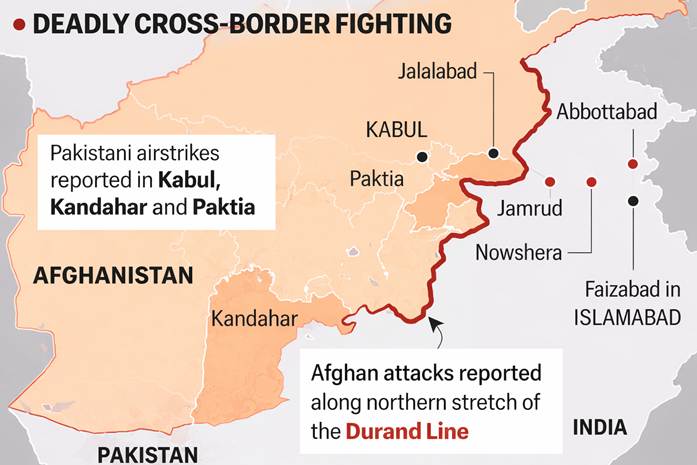
Historical Background: From Cooperation to Conflict
Pakistan was one of the principal supporters of the Taliban during the 1990s Afghan Civil War and recognized their regime between 1996 and 2001. Even after joining the US-led War on Terror post-9/11, Pakistan allegedly maintained indirect links with Taliban factions, while Taliban leadership elements operated from its territory. Islamabad believed that a Taliban-led Afghanistan would counter Indian influence and secure its western flank. However, after 2021, the Taliban prioritized autonomy over alignment with Pakistan, disrupting Islamabad’s strategic calculations.
Major Causes of the Rift
The Durand Line remains a core dispute. Drawn in 1893, it divides Pashtun populations between the two countries. Afghanistan has historically refused to formally recognize it as an international border. Pakistan’s fencing efforts and border enforcement have led to repeated skirmishes, particularly at Torkham and Chaman. For Afghanistan, the issue touches upon sovereignty and ethnic unity; for Pakistan, it is a matter of territorial integrity and national security.
The resurgence of Tehreek-e-Taliban Pakistan (TTP) has further deepened mistrust. The TTP, formed in 2007, aims to overthrow the Pakistani state and shares ideological affinity with the Afghan Taliban. Since 2022, attacks inside Pakistan have increased significantly. Islamabad accuses the Taliban regime of providing sanctuary to TTP fighters, while the Taliban deny direct support and advocate dialogue instead of military action. This dynamic represents a classic case of “blowback,” where non-state actors once tolerated for strategic reasons become security threats.
Another major factor is the Taliban’s assertion of strategic autonomy. Contrary to Pakistan’s expectations, the Taliban have engaged with China, Russia, Iran, Central Asia, and even India to diversify diplomatic ties. Their refusal to act as Pakistan’s proxy demonstrates that ideological alignment does not guarantee geopolitical obedience. This has altered regional power equations.
India’s renewed engagement with Kabul has added to Pakistan’s concerns. India has reopened its technical mission, extended humanitarian aid, and maintained limited diplomatic contact. Although India has not formally recognized the Taliban regime, growing interaction between New Delhi and Kabul is viewed by Islamabad as a strategic setback.
Security Implications for Pakistan
Pakistan faces increased terrorist violence in Khyber Pakhtunkhwa and Balochistan. The collapse of ceasefire agreements with the TTP has intensified military operations and internal instability. Economically strained and politically polarized, Pakistan must now manage both internal insurgencies and border tensions. The distinction between “good Taliban” and “bad Taliban” has blurred, exposing the limitations of its earlier security doctrine.
Regional and Global Dimensions
China seeks stability to protect CPEC investments and prevent extremist spillover into Xinjiang. Iran has tensions with the Taliban over water-sharing and minority rights. The United States remains concerned about terrorist safe havens but has limited direct leverage after withdrawal. Central Asian states fear radicalization and cross-border militancy. Thus, Afghanistan remains central to broader regional security calculations.
Implications for India
For India, the situation presents both opportunities and risks. Engagement with Kabul allows humanitarian outreach and limits Pakistan’s strategic monopoly. Connectivity initiatives like Chabahar port gain relevance. However, instability in Afghanistan could revive terror networks and affect India’s internal security. A calibrated policy—engagement without formal recognition—remains crucial.
Theoretical Perspective
From a Realist perspective, states act in self-interest; Pakistan pursued strategic depth, while the Taliban now pursue sovereign autonomy. Blowback theory explains how state-supported non-state actors can later undermine their sponsors. The security dilemma is visible in border fencing perceived as aggression. The proxy-autonomy problem highlights the difficulty of controlling ideological militias once empowered.
Way Forward
Pakistan must reconsider reliance on proxy strategies and adopt cooperative border management. The Taliban need to curb cross-border militancy to gain international legitimacy. India should maintain strategic patience, expand humanitarian diplomacy, and monitor emerging security threats. Regional cooperation remains essential to prevent further destabilization.
Conclusion
The Pakistan–Taliban rift exemplifies the unintended consequences of proxy politics. A relationship once built on strategic convergence has transformed into mutual suspicion and confrontation. The crisis underscores that non-state actors, once empowered, often evolve beyond their sponsors’ control. Sustainable peace in South Asia depends on inclusive governance in Afghanistan, effective counterterrorism cooperation, and responsible regional diplomacy.
UPSC CSE & State PCS Relevance
Prelims
- Key terms: TTP (Tehreek-e-Taliban Pakistan), Durand Line, Khost Province, Quetta Shura.
- Historical: Taliban takeover (Aug 2021), Easter attacks linkage (NTJ).
- Related: India's Afghan policy (Chabahar, INSTC).
GS-2 (International Relations)
- Afghanistan–Pakistan rift and spillover for India.
- Neighbourhood First Policy challenges.
- SCO/SAARC role in regional stability.
GS-3 (Internal Security)
- TTP as proxy threat; cross-border terrorism.
- Link to Kashmir militancy.
Essay / Interview
- “Proxy politics in South Asia: From strategic asset to security liability.”
- “Can India turn Afghanistan's instability into diplomatic opportunity?”
MCQs
1. With reference to the Pakistan–Afghan Taliban rift (February 2026), consider the following statements:
- Pakistan conducted airstrikes on TTP positions in Khost province, Afghanistan.
- The Durand Line is recognised by the Taliban as the international border with Pakistan.
- The Taliban called for dialogue to resolve the tensions.
Which of the statements given above is/are correct?
(a) 1 and 2 only
(b) 1 and 3 only
(c) 2 and 3 only
(d) 1, 2 and 3
Answer: (b)
2. The Tehreek-e-Taliban Pakistan (TTP) is primarily active in which region?
(a) Balochistan (b) Khyber Pakhtunkhwa and FATA
(c) Sindh
(d) Punjab
Answer: (b)
3. Which of the following is NOT a cause of the Pakistan–Afghan Taliban rift?
(a) Durand Line border dispute
(b) Taliban’s sheltering of TTP militants
(c) Pakistan’s recognition of Taliban government
(d) Taliban’s independent foreign policy
Answer: (c)
4. The "strategic depth" doctrine in Pakistan's foreign policy refers to:
(a) Deepening ties with China
(b) Having a friendly regime in Afghanistan as a buffer against India
(c) Naval expansion in the Arabian Sea
(d) Economic integration with Central Asia
Answer: (b)
Mains Questions
1. “The deterioration of Pakistan–Afghan Taliban relations from alliance to confrontation exemplifies the blowback of proxy politics in South Asia.” Critically examine the causes and implications of this rift for regional security. (15 marks / 250 words)
2. Discuss the impact of the Pakistan–Afghanistan border tensions on India's security concerns, particularly in relation to cross-border terrorism and regional stability. (10 marks / 150 words)
3. “India's engagement with the Afghan Taliban post-2021 is a pragmatic necessity rather than ideological endorsement.” Analyse this statement in the context of the evolving Pakistan–Taliban rift. (15 marks / 250 words)
4. Essay (250 marks) “Proxy Wars and Border Flames: The Pakistan–Afghanistan Rift and Its Ripple Effects on South Asian Geopolitics.”
CLICK HERE to download the PDF
