
5th March Editorials & Articles
↵
UPSC 360°
The Hindu Unwrapped – Daily Current Affairs Mastery for UPSC CSE (Clear that it’s based on The Hindu editorials / news analyses – very aspirant-friendly)
|
Significance |
|
India’s quiet demographic revolution marks a historic shift from population explosion to stabilization, with fertility falling below replacement level. This transition offers a demographic dividend through a large working-age population, but also signals future ageing challenges. Its significance lies in reshaping economic planning, gender roles, federal politics, and long-term social security priorities. |
The Quiet Demographic Revolution Unfolding in India
Introduction: A Historic Demographic Turning Point 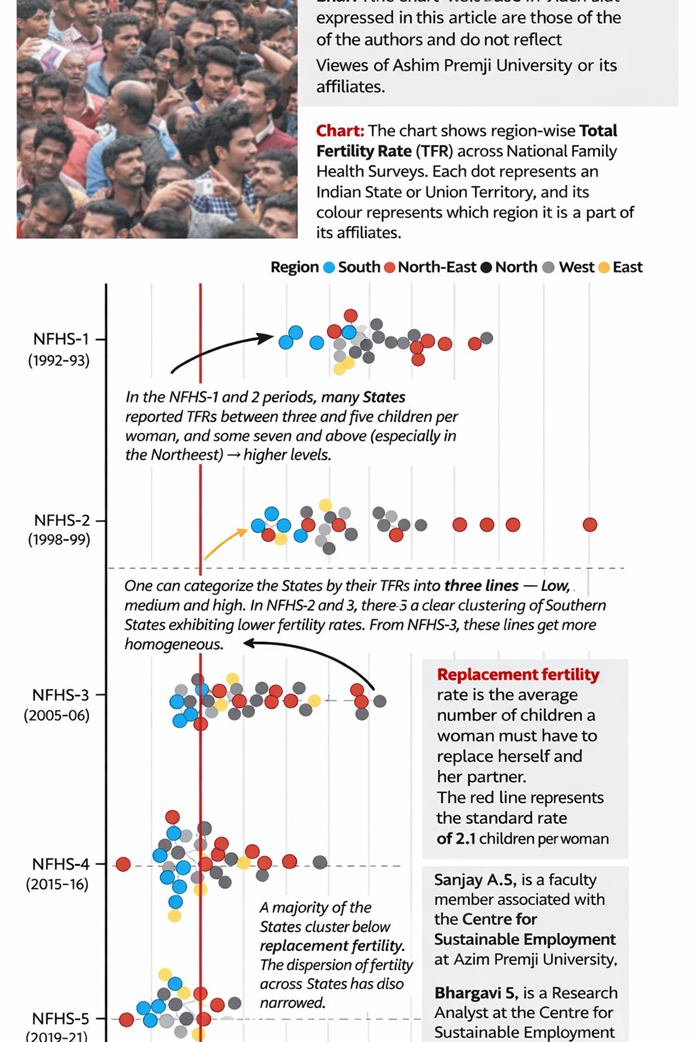
- India, historically viewed as a high-fertility, rapidly growing developing nation, is undergoing a silent yet structurally transformative demographic shift.
- According to the National Family Health Survey (NFHS-5, 2019–21), India’s Total Fertility Rate (TFR) has declined to 2.0, falling below the replacement level of 2.1 for the first time in independent India’s history.
- Replacement-level fertility implies that each generation of women is having just enough children to replace itself, signalling the transition from population expansion to stabilization.
- This marks India’s entry into the later stages of the demographic transition model, fundamentally altering its socio-economic trajectory.
Historical Context: From Population Explosion to Stabilisation
- In historical perspective, India’s fertility decline has been gradual but decisive. In the 1950s, India’s TFR was nearly 5.9 children per woman, accompanied by high infant mortality (above 140 deaths per 1,000 live births), low life expectancy (around 32 years), and minimal female literacy (below 20%).
- Large families were rational economic choices in an agrarian economy dependent on manual labour. Children contributed to household income and provided old-age security.
- However, over successive decades, improvements in public health, expansion of immunization, rising school enrolment, and economic diversification reduced both the economic utility and necessity of large families. By NFHS-1 (1992–93), TFR had fallen to 3.4; by NFHS-4 (2015–16), it was 2.2; and now it stands at 2.0.
|
Geographic Spread of Fertility Decline |
|
One of the most striking features of this transition is its nationwide spread. |
|
Southern and western states such as Kerala (1.8), Tamil Nadu (1.6), Maharashtra (1.7), and Punjab (1.6) achieved replacement fertility earlier. However, recent data show that traditionally high-fertility states are also witnessing sharp declines: |
|
|
|
|
|
Over 30 states and Union Territories are now at or below replacement fertility, indicating that demographic transition has penetrated across regional and socio-economic divides. |
Geographic Spread of Fertility Decline
- One of the most significant aspects of the current transition is its geographic diffusion. Earlier, fertility decline was concentrated in southern and western states such as Kerala (TFR 1.8), Tamil Nadu (1.6), and Maharashtra (1.7).
However, the latest data reveal that even traditionally high-fertility states like Uttar Pradesh (2.4), Bihar (3.0), Rajasthan (2.0), and Madhya Pradesh (2.0) have experienced sharp declines. Over 30 states and Union Territories are now at or below replacement fertility. - This suggests that demographic transition is no longer regionally isolated but nationally pervasive, cutting across caste, religion, and rural-urban divides.
- The drivers of this transformation are multidimensional. First, female education has played a decisive role. Female literacy has risen from around 53% in 2001 to over 70% (Census projections and NFHS estimates), and school completion rates for girls have improved significantly.
- Educated women tend to marry later — the median age at first marriage for women has risen to approximately 19.2 years (NFHS-5) — and are more likely to access contraceptive services. Second, urbanization has altered family economics.
- India’s urban population now exceeds 35%, and urban households face higher costs of housing, education, and healthcare. In such contexts, children are viewed as long-term investments rather than contributors to family labour.
- Third, improved healthcare and reduced infant mortality have lowered fertility intentions. Infant Mortality Rate (IMR) has declined from over 80 per 1,000 live births in the early 1990s to around 35 per 1,000 (Sample Registration System data).
- When child survival improves, families feel less need to “overcompensate” with higher births. Contraceptive prevalence has also expanded — NFHS-5 reports that around 67% of currently married women use some method of family planning, indicating increasing reproductive autonomy.
- Aspirational shifts have further reinforced smaller family norms. Exposure to media, digital penetration, women’s workforce participation, and rising consumer aspirations have reshaped reproductive preferences.
- Young couples increasingly prioritize career stability, urban mobility, and quality education for fewer children. The rise of nuclear families and migration-driven separation from extended kin networks also reduce traditional pressures for larger families.
- This demographic shift produces both opportunities and structural challenges. On the opportunity side, India is currently in a favourable phase of its age structure.
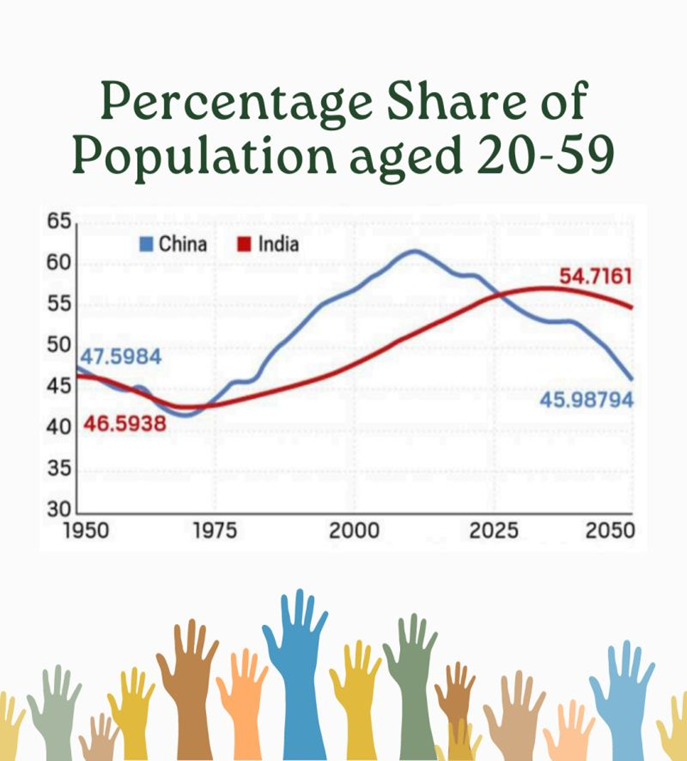
- Approximately 65% of India’s population is in the working-age group (15–59 years). The dependency ratio has declined, creating the potential for a “demographic dividend” — accelerated economic growth driven by a large labour force relative to dependents.
- If India invests effectively in skill development, manufacturing expansion, digital infrastructure, and labour-intensive sectors, it can convert this demographic window into sustained growth.
Emerging Challenge: Population Ageing 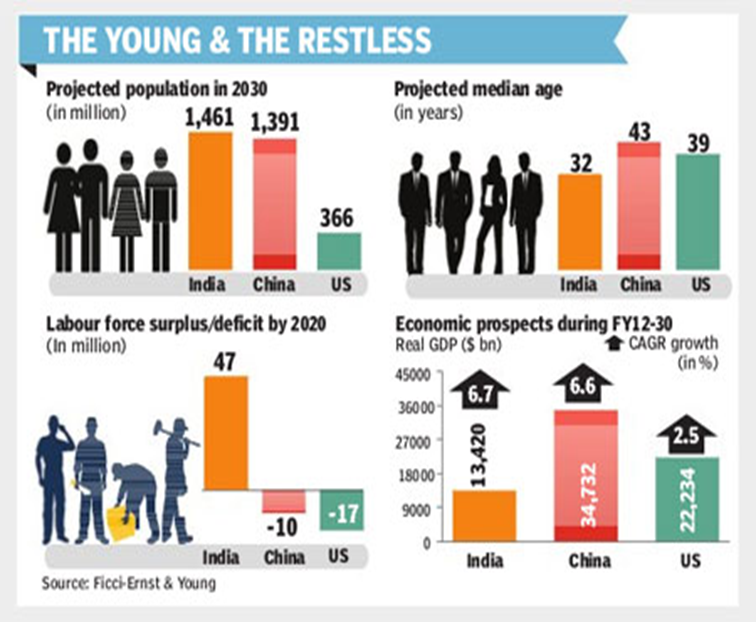
- However, the dividend is time-bound and conditional. Without adequate job creation, the demographic advantage may turn into demographic stress. Youth unemployment rates remain elevated, particularly among educated urban youth.
- Underemployment and informalization continue to dominate labour markets. If economic absorption fails to match demographic supply, social discontent may intensify.
- Another emerging challenge is population ageing. As fertility declines and life expectancy rises (now above 69 years), India’s elderly population is projected to increase significantly. By 2050, nearly 20% of India’s population may be aged 60 and above.
- States like Kerala and Tamil Nadu already exhibit rising old-age dependency ratios. This shift will strain pension systems, healthcare infrastructure, and traditional family-based support structures. India must gradually prepare for ageing-related expenditures even as it capitalizes on its youthful workforce.
- Regional imbalances present an additional political dimension. Southern states achieved fertility decline earlier and now have slower population growth. Northern states, though converging, still have relatively higher fertility.
- Future delimitation of parliamentary constituencies based on population could shift political representation toward higher-growth states, raising concerns in southern regions about fiscal transfers and federal balance. Thus, demographic change intersects with federal politics.
- In essence, India’s demographic revolution marks a paradigm shift from quantity to quality. The policy emphasis is no longer on controlling population numbers but on enhancing human capital.
- The central question is whether India can transition from demographic transition to demographic transformation — investing in education, healthcare, gender equality, urban planning, and social security to sustain growth in an ageing future.
- India’s demographic journey reflects a broader narrative of socio-economic modernization. The quiet revolution unfolding is not merely about declining birth rates; it is about changing aspirations, shifting gender roles, evolving economic structures, and emerging governance challenges. The coming decades will determine whether this demographic shift becomes India’s greatest strength or a missed opportunity.
UPSC CSE & State PCS Relevance
Prelims
- Total Fertility Rate (TFR) & replacement level (2.1)
- NFHS-5 key finding: National TFR = 1.91
- Demographic Dividend window: ~2025–2040
- Old-age dependency ratio projections
GS-1 (Society & Geography)
- Demographic transition & regional variations
- North–South divide in fertility & population
GS-2 (Polity & Governance)
- Delimitation after 2031 Census → political power shift
- Social security & pension reforms
GS-3 (Economy)
- Shrinking labour force & economic growth
- Ageing population & fiscal burden
Essay / Interview
- “India’s silent demographic transition: From population bomb to ageing society.”
- “Low fertility in India: Dividend or demographic disaster?”
MCQs
1. According to NFHS-5 (2019–21), India’s national Total Fertility Rate (TFR) stands at:
(a) 1.6
(b) 1.91
(c) 2.1
(d) 2.4
Answer: (b)
2. Replacement level fertility rate is internationally accepted as:
(a) 1.8
(b) 2.0
(c) 2.1
(d) 2.5
Answer: (c)
3. Which state has the lowest TFR as per NFHS-5?
(a) Bihar
(b) Uttar Pradesh
(c) Andhra Pradesh
(d) Rajasthan
Answer: (c)
4. By 2050, India’s old-age dependency ratio is projected to be in which range?
(a) 10–15
(b) 20–28
(c) 30–35
(d) 40–45
Answer: (b)
Mains Questions
1. “India is quietly entering the low-fertility regime, with profound long-term implications for economy, society and polity.” Discuss the drivers of this transition and suggest policy measures to prepare for an ageing population. (15 marks / 250 words)
2. Analyse the emerging north–south divide in fertility rates in India. How might this affect future political representation and resource allocation? (10 marks / 150 words)
3. “The demographic dividend window is closing faster than anticipated.” In light of recent fertility trends, critically evaluate India’s preparedness and recommend reforms. (15 marks / 250 words)
4. Essay (250 marks) “India’s Silent Demographic Revolution: From Population Explosion to Ageing Society – Challenges and Choices.”
CLICK HERE to download the PDF
