
8th April Editorials & Articles
|
Significance |
|
The Sabarimala case highlights the tension between religious freedom and fundamental rights. While the government stresses Hinduism’s diversity and opposes rigid definitions, the judiciary emphasizes equality and constitutional morality. The debate centers on whether courts should define essential religious practices or respect community traditions within constitutional limits. |
UPSC 360°
The Hindu & Indian Express Unwrapped – Daily Current Affairs Mastery for UPSC CSE (Clear that it’s based on The Hindu editorials / news analyses – very aspirant-friendly)
Sabarimala Case and the Debate on Religious Diversity: A Constitutional Perspective
Introduction
- The ongoing proceedings in the Supreme Court of India regarding the Sabarimala issue have reignited a fundamental constitutional debate—whether courts can define religion and its essential practices. The Union government has argued that rigid definitions may suppress the inherent diversity of Hinduism, raising critical questions about religious freedom, judicial intervention, and constitutional morality.
Background of the Sabarimala Case
- The controversy revolves around the Sabarimala Temple in Kerala, where traditionally women aged 10–50 were restricted from entry.
- In the landmark Indian Young Lawyers Association v. State of Kerala (2018), a Constitution Bench of the Supreme Court ruled that:
- The restriction violated Article 14 (Equality)
- It infringed Article 25 (Freedom of Religion)
- Women’s exclusion was unconstitutional
However, review petitions led to the formation of a larger bench to examine broader constitutional questions.
Government’s Stand: Diversity Over Definition
The Centre has argued that: 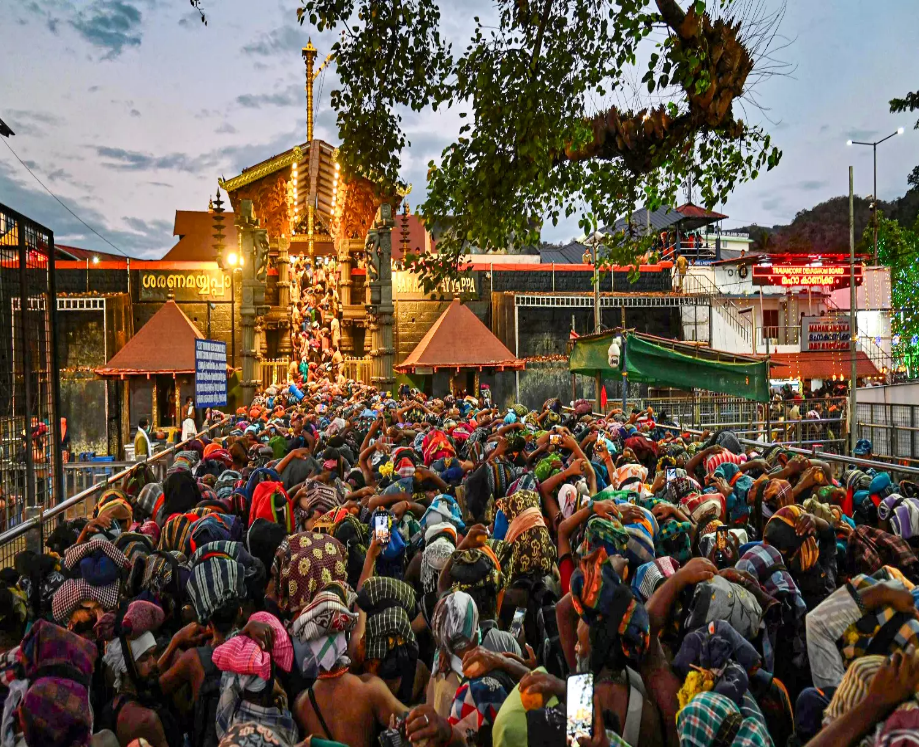
1. Hinduism as a Plural Tradition
- Hinduism is not a monolithic religion
- It consists of diverse sects, beliefs, rituals, and traditions
- Imposing strict definitions would undermine this plurality
2. No Fixed Canon or Authority
- Unlike Abrahamic religions, Hinduism lacks:
- A single founder
- A uniform doctrine
- Centralized authority
Thus, defining “essential religious practices” becomes complex.
3. Risk of Judicial Overreach
- Courts defining religion may:
- Interfere in matters of faith
- Replace community practices with legal interpretations
- Disturb long-standing traditions
Key Constitutional Provisions Involved
Article 25 – Freedom of Religion
- Guarantees freedom of conscience and religion
- Subject to public order, morality, and health
Article 26 – Rights of Religious Denominations
- Allows religious groups to manage their own affairs
- Includes the right to maintain traditions
Article 14 – Equality Before Law
- Prohibits discrimination
- Central to arguments against exclusionary practices
Doctrine of Essential Religious Practices (ERP)
The ERP doctrine has been used by courts to determine whether a practice is protected under the Constitution.
Issues with ERP Doctrine
- Courts decide what is “essential” to religion
- Leads to subjective interpretation
- May undermine religious autonomy
The current case questions whether courts should continue applying this doctrine.
Judicial Observations and Past Trends
The Supreme Court has taken varied approaches:
- In some cases, it has protected religious practices
- In others, it has prioritized fundamental rights over tradition
The Sabarimala judgment leaned towards:
- Gender equality
- Constitutional morality over custom
Core Issues in the Present Debate
1. Who Defines Religion?
- State or Judiciary vs Religious Communities
2. Individual Rights vs Collective Faith
- Women’s rights vs religious traditions
3. Constitutional Morality vs Social Practices
- Progressive interpretation vs cultural continuity
Arguments Supporting the Centre’s View
- Protects religious diversity and autonomy
- Avoids one-size-fits-all approach
- Respects India’s civilizational complexity
Arguments Against the Centre’s View
- May justify discriminatory practices
- Weakens judicial protection of fundamental rights
- Risks status quo bias in regressive customs
Comparative Perspective
- USA: Strong separation of church and state
- France: Strict secularism (Laïcité)
- India: Unique model balancing religion and rights
India follows a “principled distance” model, not strict separation.
Implications of the Case
Legal
- Redefinition of ERP doctrine
- Limits of judicial intervention
Social
- Gender justice vs tradition debate
- Impact on other religious practices
Political
- Centre vs Judiciary dynamics
- Role of state in religious matters
Way Forward
- Develop clear guidelines for ERP application
- Ensure judicial restraint with sensitivity
- Promote dialogue between communities and institutions
- Balance:
- Fundamental Rights
- Religious Freedom
Conclusion
- The Sabarimala case is not merely about temple entry—it is about the soul of the Constitution. It raises a deeper question:
- Should the State define religion, or should religion evolve organically within society?
- The answer lies in maintaining a delicate balance between individual dignity and collective faith, ensuring that India remains both constitutionally progressive and culturally plural.
UPSC CSE & State PCS Relevance
Prelims
- Key terms: Sabarimala Case (2018), Doctrine of Essential Religious Practices (ERP), Article 25, Article 26, Article 14, Constitutional Morality, Religious Denominations.
GS-2 (Polity & Governance)
- Fundamental Rights vs Religious Freedom; Judicial review of religious practices; Secularism in India; Balance between individual rights and community practices.
GS-1 (Indian Society)
- Religious pluralism and diversity in Hinduism; Social reform vs tradition; Gender and religion.
Essay / Interview
- “Courts and Religion: Should Judiciary Define Essential Religious Practices?”
- “Constitutional Morality vs Religious Autonomy: The Evolving Debate in India.”
- “Protecting Diversity While Ensuring Equality: Lessons from the Sabarimala Case.”
MCQs (Prelims Standard)
- Consider the following statements regarding the Sabarimala case:
- The 2018 Supreme Court judgment allowed women of all ages to enter the Sabarimala Temple.
- The Union Government has argued that Hinduism’s diversity should not be undermined by rigid definitions of essential practices.
- Article 26 deals with the freedom of conscience and right to profess religion. Which of the statements given above is/are correct?
(a) 1 and 2 only
(b) 2 and 3 only
(c) 1 only
(d) 1, 2 and 3
Answer: (a)
- The Doctrine of Essential Religious Practices was developed by the Supreme Court to determine:
(a) Scope of Article 19(1)(a)
(b) Which religious practices are protected under Articles 25 and 26
(c) Powers of the Election Commission
(d) Validity of personal laws
Answer: (b)
- Which Article of the Constitution guarantees freedom of religion subject to public order, morality, and health?
(a) Article 14
(b) Article 19
(c) Article 25
(d) Article 26
Answer: (c)
- The Sabarimala Temple entry restriction was traditionally based on the belief that the presiding deity is:
(a) A warrior god
(b) A Naisthika Brahmachari (eternal celibate)
(c) A goddess of fertility
(d) A form of Shiva
Answer: (b)
- The current larger bench in the Sabarimala review petitions is examining:
(a) Only the validity of the 2018 judgment
(b) Broader questions on judicial intervention in religious matters and the ERP doctrine
(c) Only women’s entry rights
(d) Temple management issues
Answer: (b)
Mains Questions
- “The Sabarimala case raises fundamental questions about the limits of judicial intervention in religious practices.” Critically examine the constitutional debate on the Doctrine of Essential Religious Practices and the Centre’s argument on preserving Hinduism’s diversity. (15 marks / 250 words)
- Discuss the tension between individual fundamental rights and collective religious freedom in the context of the ongoing Sabarimala proceedings. How should the Supreme Court balance constitutional morality with religious pluralism? (15 marks / 250 words)
- “Defining religion through judicial pronouncements may undermine the organic evolution of faith traditions.” Analyse this statement with reference to the Sabarimala case and Article 25 and 26 of the Constitution. (10 marks / 150 words)
- Essay (250 marks) “Religious Freedom versus Constitutional Morality: The Evolving Role of the Judiciary in India’s Plural Society.”
Click Here to downoad the PDF
