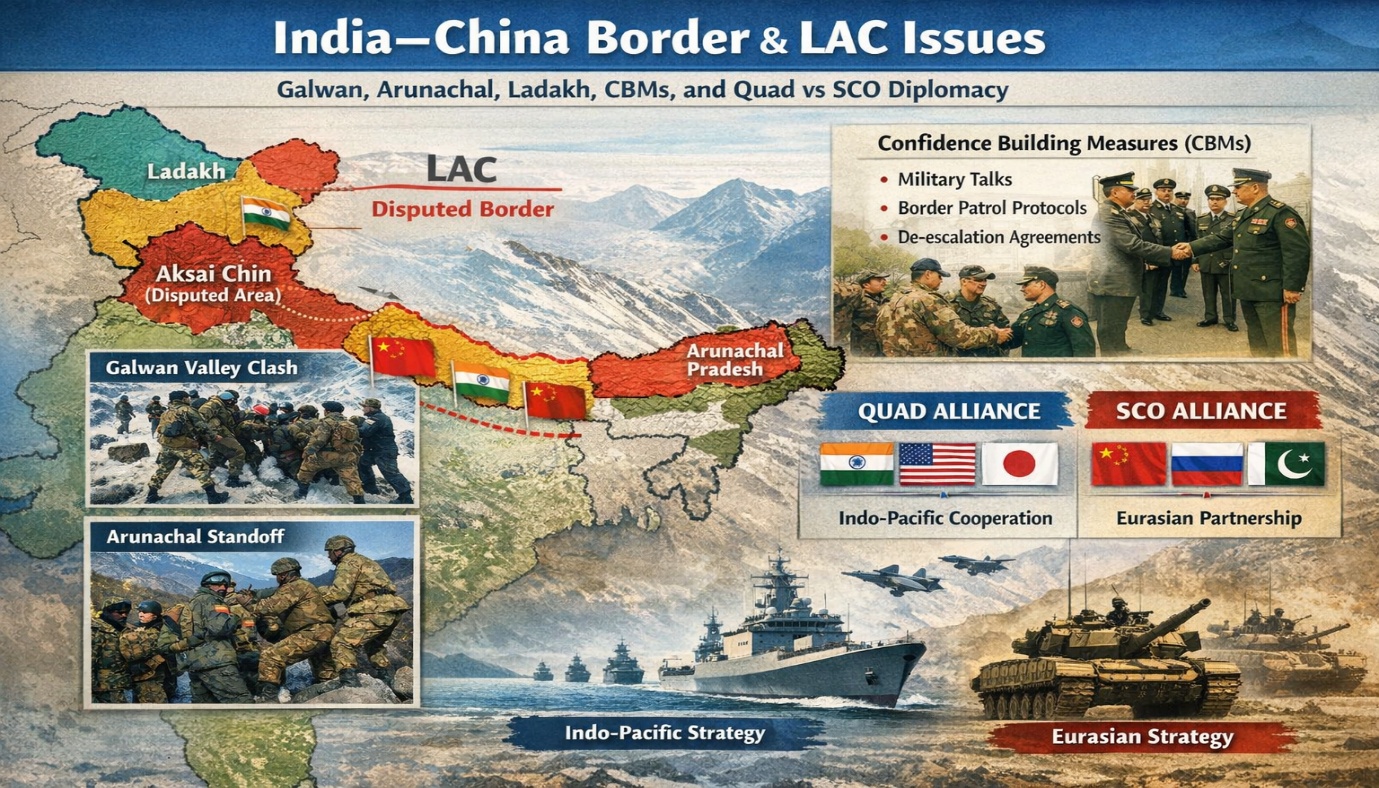
India–China Border & LAC Issues: Galwan, Arunachal, Ladakh, CBMs, and Quad vs SCO Diplomacy
India–China Border & LAC Issues: Galwan, Arunachal, Ladakh, CBMs, and Quad vs SCO Diplomacy
Introduction
India and China share one of the longest disputed borders in the world. The Line of Actual Control (LAC) has been a major source of tension, especially after recent military stand-offs in Ladakh and Arunachal Pradesh. The India–China border issue has significant geopolitical, military, and diplomatic implications for regional and global stability.
1. What is the Line of Actual Control (LAC)?
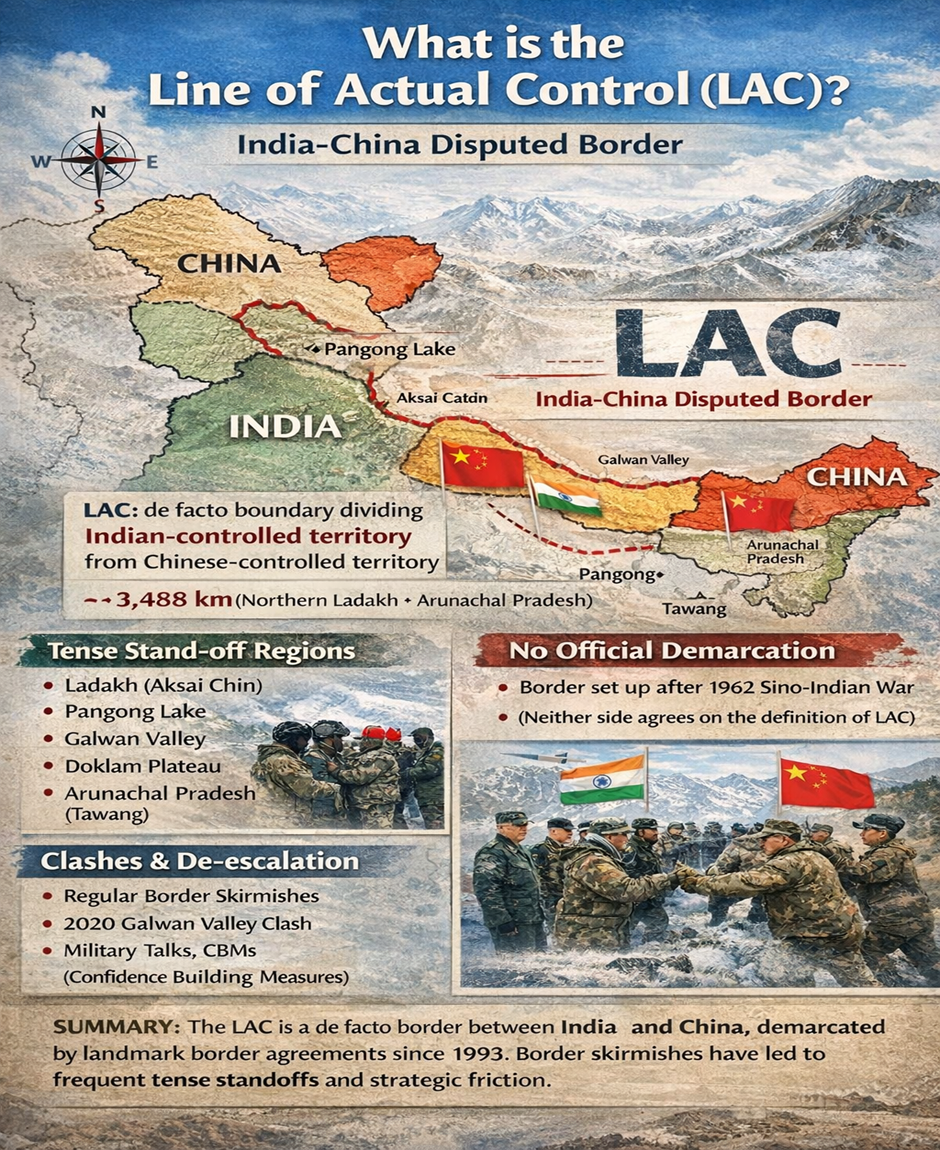
The Line of Actual Control (LAC) is the de facto boundary between India and China. Unlike an internationally recognized border, the LAC is not clearly demarcated, and both countries have different perceptions of its alignment.
Key Facts about LAC:
- Length: Approximately 3,488 km
- Divided into three sectors:
- Western Sector: Ladakh
- Middle Sector: Uttarakhand and Himachal Pradesh
- Eastern Sector: Arunachal Pradesh
The ambiguity of the LAC often leads to patrol confrontations and military standoffs.
2. Galwan, Arunachal, and Ladakh Disputes
A. Galwan Valley Clash (Ladakh)
The Galwan Valley clash in June 2020 marked the most serious military confrontation between India and China in decades. Soldiers from both sides lost their lives in hand-to-hand combat.
Strategic Importance:
- Located near the Darbuk–Shyok–DBO Road (DSDBO Road)
- Critical for India’s connectivity to Daulat Beg Oldie (DBO)
- Close to Aksai Chin, which is controlled by China
The clash led to a massive military buildup and disengagement talks.
B. Arunachal Pradesh Dispute
China claims Arunachal Pradesh as “South Tibet.” The most sensitive region is Tawang, due to its religious and strategic significance.
Key Issues:
- China’s policy of renaming Indian locations to assert claims
- Frequent military patrols and infrastructure development
- Strategic importance for India’s Northeast security
C. Ladakh Border Tensions
Ladakh remains the most militarized sector of the LAC.
Major Flashpoints:
- Aksai Chin
- Pangong Lake
- Depsang Plains
- Hot Springs and Chumar
Ladakh is crucial for China’s connectivity between Xinjiang and Tibet, making it strategically vital.
3. Confidence Building Measures (CBMs)
Confidence Building Measures (CBMs) are diplomatic and military agreements designed to prevent misunderstandings and conflicts.
Major India–China CBM Agreements:
1993 Border Peace and Tranquility Agreement
- First major agreement to maintain peace along the border.
1996 Military CBMs Agreement
- Restrictions on military deployments
- Advance notification of exercises
2005 Political Parameters Agreement
- Framework for resolving the boundary dispute.
2013 Border Defence Cooperation Agreement (BDCA)
- Hotlines, joint exercises, and flag meetings.
Current Status:
After the Galwan incident, trust has declined, and many CBMs have weakened due to increased troop deployment and infrastructure expansion.
4. New Border Infrastructure Projects
India’s Border Infrastructure Push
India has significantly accelerated border infrastructure development.
Key Projects:
- Darbuk–Shyok–DBO Road (DSDBO Road)
- Atal Tunnel (Rohtang Tunnel)
- Sela Tunnel (Arunachal Pradesh)
- Strategic roads by the Border Roads Organisation (BRO)
- Advanced Landing Grounds (ALGs) like DBO, Nyoma, and Fukche
- Surveillance using satellites, drones, and integrated border management systems
China’s Infrastructure Developments
China has also expanded its infrastructure near the border:
- High-speed railways in Tibet
- Dual-use airports (civilian + military)
- Xiaokang border villages for strategic and demographic purposes
This has led to an infrastructure race and strategic competition.
5. Quad vs SCO Diplomacy
Quad (Quadrilateral Security Dialogue)
Members:
- India
- United States
- Japan
- Australia
Objectives:
- Promote a Free and Open Indo-Pacific (FOIP)
- Counterbalance China’s influence
- Enhance maritime security
- Strengthen technology and supply chains
SCO (Shanghai Cooperation Organisation)
Members:
China, Russia, India, Pakistan, and Central Asian countries.
Objectives:
- Counter-terrorism cooperation
- Regional security and economic collaboration
- Promote a multipolar world order
India’s Strategic Balancing Act
India is a member of both Quad and SCO, reflecting its multi-alignment foreign policy.
- Quad: Strengthens India’s Indo-Pacific strategy and partnerships with the West.
- SCO: Enables engagement with China and Russia and ensures presence in Eurasian geopolitics.
This dual engagement enhances India’s strategic autonomy.
Challenges and Way Forward
Key Challenges:
- Border disputes and military standoffs
- Lack of trust and perception gaps
- Infrastructure competition
- Geopolitical rivalry in the Indo-Pacific
Way Forward:
- Clear demarcation of the LAC
- Strengthening CBMs and military diplomacy
- Gradual disengagement and demilitarization
- Continued infrastructure development in border areas
- Balanced diplomacy through Quad and SCO
Conclusion
The India–China border dispute is not just a territorial issue but a complex geopolitical challenge involving military, diplomatic, and strategic dimensions. Managing the LAC tensions while maintaining diplomatic engagement through multilateral platforms like Quad and SCO will be crucial for regional peace and India’s national security.
